8 Best Porn Addiction Apps in 2026: An Honest Comparison
We tested the leading porn addiction apps and compared their blocking, accountability, recovery content, Christian support, platforms, and current prices.

Obex
Obex Team
Most porn addiction apps are great at selling you hope. Far fewer are useful when you’re tired, alone, and one search away from doing the same thing again.
I learned that after testing the apps people usually recommend for quitting porn. Most of them were excellent for the first ten minutes. The onboarding was polished. The questions felt personal. By the end, you had a plan, a dramatic progress screen, and the sense that this time might be different.
Then you opened the actual app.
Too often, the useful part was a streak counter surrounded by generic articles, abstract promises, and a subscription. None of that is worthless. It just did not answer the question I cared about: what will this app help me do when the urge is already here?
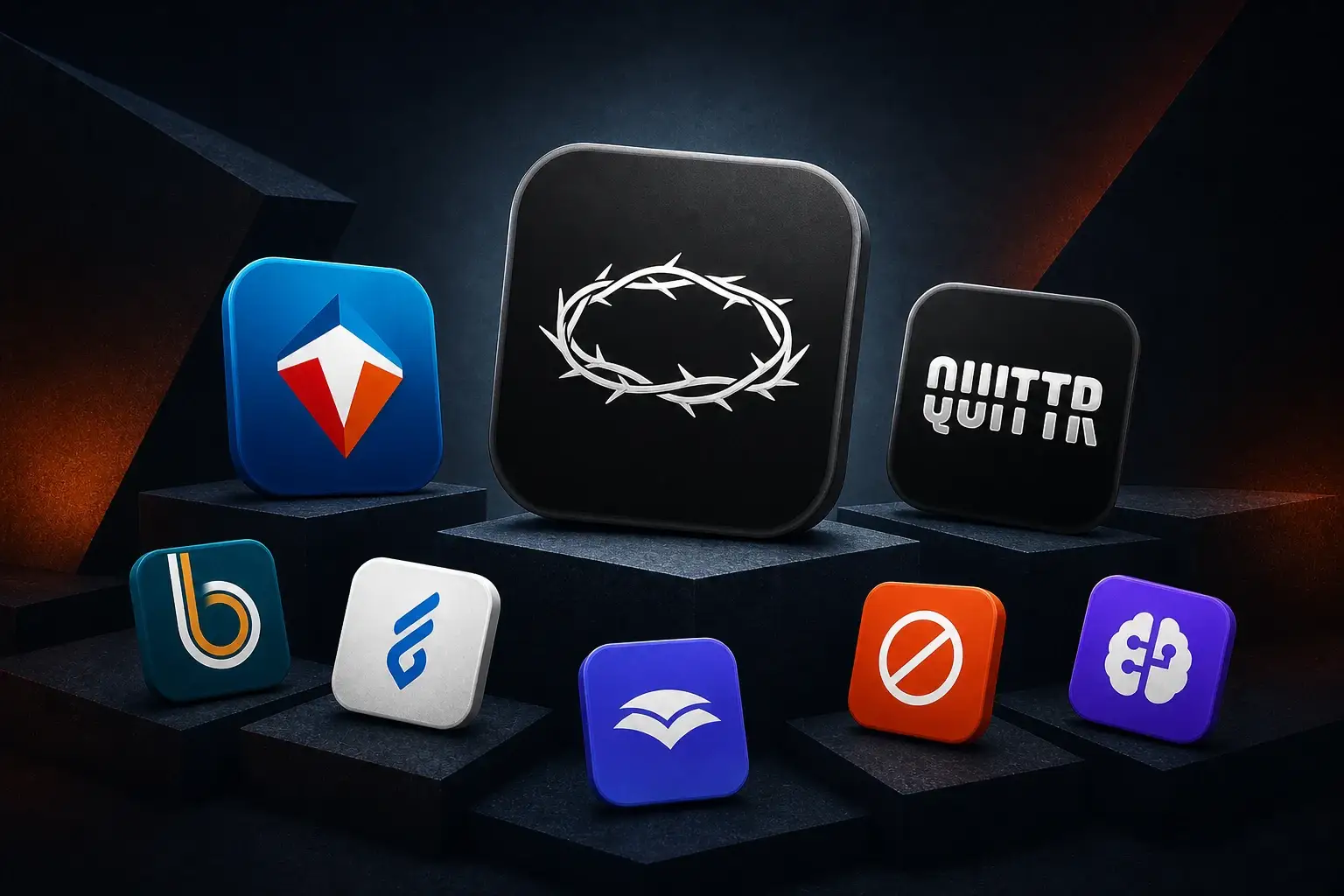
This comparison is meant to save you that cycle. It sorts the apps by the job they actually do, not the promises on their store page. You’ll be able to tell whether you need a hard blocker, a real accountability relationship, a daily program, or a faith-first system that combines them, without downloading eight apps and sitting through eight sales pitches.
Quick comparison
| App | Best for | Platforms | Price |
|---|---|---|---|
 ObexOur app ObexOur app | Best forFaith-first recovery with blocking and real community | PlatformsiPhone; free blocker for macOS | PriceFree blocker + full-access trial |
 Victory by Covenant Eyes Victory by Covenant Eyes | Best forAccountability with someone who knows you | PlatformsiPhone, iPad, Android, Mac, Windows | PriceFree basics; $19.99/month or $219.99/year for the full plan |
 QUITTR QUITTR | Best forLots of tools across iPhone, iPad, and Android | PlatformsiPhone, iPad, Android | Price$9.99–$14.99/month, $19.99–$29.99/year, or $49.99 lifetime |
 Brainbuddy Brainbuddy | Best forPeople who want a prescribed routine | PlatformsiPhone, iPad, Android | Price$2.99/week, $12.99/month, or $99.99/year |
 Fortify Fortify | Best forLearning triggers and patterns over time | PlatformsiPhone, Android, web | PriceFree account; store purchases currently range from $12 to $199.99 |
 Canopy Canopy | Best forBlocking explicit media across a household | PlatformsiPhone, Android, Mac, Windows, ChromeOS | Price$8.33–$19.99/month depending on plan and store |
 BlockerX BlockerX | Best forDirect site, keyword, and search blocking | PlatformsiPhone, Android, Chrome, Mac, Windows | PriceOffers currently range from $2.99 add-ons to $149.99 lifetime |
 Rewire Rewire | Best forA guided recovery plan built for Android | PlatformsAndroid | PriceStore purchases currently range from $4.99 to $24.99 |
We pulled these prices from the apps on August 24, 2026. Offers change, so check the final price on your device before subscribing.
How we ranked the apps
We did not count features and hand the top spot to the longest list. A recovery app can have twenty dashboard tiles and still be useless when your usual pattern starts.
We tested a bunch of porn recovery apps because new ones keep popping up and claiming they’re the best. Most aren’t. There were enough alternatives and enough noise that we decided to make this comparison and tell you what each app is actually good at.
We asked four simpler questions:
- Can it make access harder? Blocking matters, especially when an impulsive search is the first domino.
- What happens during an urge? A breathing timer, a call, a prayer, a person, or a concrete action beats another graph.
- Is there a real human loop? Community and accountability only count if somebody can notice, answer, or follow up.
- Is the material worth returning to? Recovery content should help you understand and change the pattern, not pad the subscription.
Different people need different answers. That is why Victory can rank above a prettier all-in-one app, and why Canopy can still be the right purchase for a family even though it is not a recovery program.
The eight apps

Obex
Our appChristian all-in-one recoveryBuilt and used by us
I'm Luca, the founder of Obex. I started building it after trying recovery apps that were brilliant at onboarding and strangely empty afterward. They could make you feel hopeful for ten minutes, then leave you with a streak counter, a thin library of generic articles, and very little to do when an urge actually arrived.
Obex is our answer to that. The iPhone app combines website and app blocking, Panic Mode, progress tracking, journaling, community, and daily recovery work. You can create an account and use the core blocker without paying. Full access starts with a free trial. There's also a free native macOS blocker that works across browsers and apps.
The bigger difference is who is on the other side. Our founder and a team of four pastoral helpers, including people with firsthand experience of this struggle, are regularly in the community replying to members. The guidance is faith-first and informed by behavioral and clinical research. We built the content for Obex instead of filling a tab so the feature list would look complete.
The honest limitation is platform coverage. The recovery app is on iPhone today, while the macOS companion focuses on blocking. Obex is also younger than Covenant Eyes or Brainbuddy. If you're a Christian on iPhone and want practical tools, substantial guidance, and people who will actually answer, it's still the app we'd choose.
Pros
- Blocking, Panic Mode, journaling, progress tracking, and community in one app
- A free native macOS blocker for browsers and apps
- Faith-first guidance informed by science instead of generic filler
- Founders and pastoral helpers actively reply in the community
Cons
- The full recovery app is iPhone-only for now
- Newer and smaller than the established names here

Victory by Covenant Eyes
Christian screen accountabilitySeen in real use; official details verified
Victory belongs near the top because it takes the human part seriously. Friends of ours have used it, so we've seen what happens beyond the store page. Covenant Eyes monitors screen activity, flags concerning material, and lets a person you trust see reports and follow up. It also includes blocking, check-ins, community, and Christian learning material.
That other person is the point. We're weak when everything stays private. Christian recovery still requires your own choices, but it was never meant to be an isolated project. A good ally can notice the pattern, ask the uncomfortable question, and help you get back up before one bad evening turns into a hidden week.
Victory does expect you to bring that ally. Its community and free material are useful, but the strongest accountability loop depends on somebody in your life reading the reports. Obex takes a different approach by also putting an active team and community inside the app. If you already have the right person and want established cross-device monitoring, Victory is excellent.
Pros
- Human accountability is the center of the product
- Combines activity reporting with blocking
- Established company with broad desktop and mobile support
- Free community, check-ins, and introductory material
Cons
- You need an ally who will actually engage
- Protection and setup differ by device

QUITTR
General all-in-one recoveryTested by us
QUITTR has almost every feature people expect: streaks, urge support, a blocker, community, educational material, a personal plan, and an AI coach. The onboarding is polished and energetic. It does a good job of making recovery feel possible, and its platform coverage is much better than Obex's today.
When we used it, the recovery material was the weak point. Much of it felt interchangeable with the generic articles you can find in other habit apps. It named patterns and explained why porn can become compulsive, but too often stopped before giving us a memorable answer for the next difficult night.
That doesn't make QUITTR a bad app. It remains the broadest general recommendation here if you need Android or iPad, want an AI coach, or prefer a secular product. Just don't assume a long feature list means every part has equal depth.
Pros
- Broad recovery and blocking toolkit
- Works on iPhone, iPad, and Android
- Polished onboarding, community, urge tools, and an AI coach
Cons
- Recovery material felt generic in our testing
- Pricing and the number of features can be confusing

Brainbuddy
Structured daily programTested by us
Brainbuddy is built around a 100-day program. Each day gives you exercises, check-ins, trigger tracking, journaling, and progress reports, with community and a web filter around the edges. If you keep opening it, there is always a next step waiting.
We liked the structure more than the language around it. The brain-rewiring framing can feel grander than the exercises themselves, and after the strong onboarding the program sometimes starts to feel like homework. Still, a fixed routine is useful if improvising has not worked for you. Choose Brainbuddy for structure, not for the strongest blocking or a Christian approach.

Fortify
Education and reflectionTested by us
Fortify feels more like a course than a blocker. Daily check-ins, journaling, goals, lessons, SOS tools, community, and personal insights help you slow down and understand what keeps repeating. Of the general programs we tried, it makes the strongest case for sitting with the work instead of merely protecting a streak.
The tradeoff is urgency. Fortify is better at reflection than hard access control, and the product has widened into general mental wellness. That can be helpful, but it makes the recovery path feel less direct. Pick it if you want to study your patterns. Pair it with a blocker if access is your immediate problem.

Canopy
Family filteringOfficial product and pricing research
Canopy is a filter, not a recovery program, and it is better for being clear about that. It detects and filters explicit images and video, blocks sites and apps, and lets a parent or accountability partner handle requests. One subscription can cover a household across the major operating systems.
Choose it when access is the problem you need to solve first. It won't teach you much about secrecy, stress, or what to do once the urge has already started. Pricing also changes by device count and purchase channel, so the website and app stores can show different numbers. Canopy is a strong layer of protection, not the whole recovery plan.

BlockerX
Cross-platform blockingTested by us
BlockerX goes straight at access. It can block sites, keywords, images, and searches, then adds usage statistics, accountability, courses, and community around the blocker. We found it easier to understand when we treated those extras as support for the filter rather than the main product.
The pricing menu is unusually broad, with small add-ons, monthly and annual offers, and a lifetime purchase appearing in the current US store data. Features also vary by platform. It is a useful guardrail if searching and browsing are the immediate failure point, but its recovery material is not as substantial as the programs above.

Rewire
Android recoveryOfficial listing research; not personally tested
Rewire is the one app here we haven't personally tested, so we're not going to pretend its store listing tells us how it feels after three weeks. On paper, it combines streaks and milestones with urge exercises, breathing, guided sessions, reflection, and community. The Android-only focus makes it more coherent than an afterthought port.
It is worth a look if you use Android and want daily work rather than a bare counter. It is also newer and less proven than Brainbuddy, Fortify, or Victory. Treat this as a researched option, not a firsthand endorsement, and use the free entry point before paying for the program.
Best porn addiction app for each situation
Best for Christians on iPhone: Obex. It gives you blocking, a response for the difficult moment, a community where the team actually participates, and a recovery path built around faith rather than decorated with it. Add the free macOS blocker if your laptop is part of the problem.
Best for accountability with someone you trust: Victory. If that person will read reports and ask hard questions, Victory may be the strongest single accountability tool here. The software creates visibility, but the relationship is what changes the room. Through Christ we can change, but pretending we are strongest alone is usually how secrecy survives.
Best for Android or iPad: QUITTR. We prefer Obex’s material and community model, but QUITTR has broader platform support and a capable general toolkit. If you’re waiting for Obex on Android, join the Android waitlist.
The part no app can automate
The best thing Victory gets right is that recovery changes when another person knows.
You can build an impressive private system and still negotiate with yourself at midnight. An ally, a pastor, a friend, or a community interrupts that closed loop. They can remind you what you said yesterday. They can notice when you disappear. They can pray with you, challenge you, and help you stand up without turning one failure into an identity.
Obex handles this differently from Victory. Victory gives detailed accountability tools to somebody you already trust. Obex has a community where our founder, four pastoral helpers, and members with firsthand experience are regularly present. One does not make the other obsolete. If you have a committed ally, use that gift. If you do not, choose an app where asking for help does not feel like shouting into an empty feed.
Blocking is not the boring feature
Every recovery app wants to talk about transformation. On a bad night, a blocker that turns one tap into ten annoying steps can be more useful than an inspiring lesson.
Obex, Victory, QUITTR, Canopy, and BlockerX all offer some form of blocking, but they are not interchangeable. Obex combines blocking with its recovery system and has a free macOS companion. Victory adds screen accountability. Canopy is designed for strong household filtering. BlockerX focuses on sites, keywords, and searches. Device coverage and anti-tampering behavior differ, so install the trial on every device that matters before you decide.
A blocker still cannot carry the whole plan. If you can bypass it on another device, keep your struggle secret, and have no response once an urge starts, the blocker is doing all the work. Add a repeatable action and a person you can contact. Our porn addiction recovery roadmap can help you build that second layer.
How to test an app before paying
Do not spend the free trial browsing lessons on a calm afternoon. Test the job you are hiring the app to do.
- Set up blocking on every phone and computer you actually use.
- Search for the exact route that usually starts the problem.
- Open the urge tool when you are restless, not while admiring the interface.
- Check what an ally receives and whether they understand it.
- Read two or three lessons. If they already feel generic, the rest probably will too.
- Put the renewal date in your calendar before the trial ends.
A free download is not the same as a free program. Several apps here show different offers by region, account, or purchase channel. The range in our table is more honest than pretending there is one universal monthly price.
Product and pricing pages
These are the pages we used to verify platforms, features, and current offers on August 24, 2026. We used our own testing for the editorial judgments above.
- Obex on the App Store
- Obex for macOS
- Victory by Covenant Eyes
- QUITTR on the App Store
- Brainbuddy on the App Store
- Fortify
- Canopy plans
- BlockerX
- Rewire on Google Play
Pick the app that fixes the part of your setup that keeps failing. If you’re Christian, use an iPhone, and want blocking, serious guidance, and people who will actually answer, try Obex. The macOS blocker is free.