Abstinence Violation Effect: Overcome Relapse
Grasp the abstinence violation effect: the psychological trap turning a small slip into full relapse. Get actionable porn recovery strategies.

Obex
Obex Team
You were doing fine an hour ago.
Then something happened. Maybe you got tired, lonely, stressed, angry, or just careless for a minute. You clicked one image. You watched one clip. Right after, the thought hit hard: “I blew it.”
For a lot of people, that first mistake isn’t what causes the significant damage. The damage starts with the next thought. “My streak is gone. I already failed. I might as well keep going.” That’s the moment a slip turns into a binge.
If that pattern feels familiar, you’re not weak and you’re not uniquely broken. You’re dealing with a known psychological trap. It has a name. And once you can spot it, you can start to interrupt it.
Table of Contents
- That Moment a Small Slip Becomes a Big Relapse
- What Is the Abstinence Violation Effect
- How the AVE Shows Up in Porn Recovery
- How to Prevent the AVE Spiral Before It Starts
- Your Action Plan for the Moment After a Slip
- Using Recovery Tools to Beat the AVE
- Frequently Asked Questions About Slips and Relapses
That Moment a Small Slip Becomes a Big Relapse
It usually happens in a quiet, ordinary moment. Late at night, phone in hand, a quick search that feels small enough to justify. Then the line gets crossed, and danger shows up a few seconds later.
The thought is familiar. “I already messed up, so I might as well keep going.”
That is the point where a slip often turns into a binge in porn recovery. The first click matters, but the meaning attached to that click matters even more. People do not usually spiral because one urge appeared. They spiral because the mind turns one mistake into a verdict.
The trap is predictable
The abstinence violation effect, often shortened to AVE, describes that shift. A lapse gets interpreted as total failure, and once that story takes over, more acting out starts to feel pointless to resist.
In porn recovery, this often sounds brutally simple. “I peeked, so my streak is gone.” “I already failed, so I may as well finish.” “I’ll restart tomorrow.” Those thoughts feel honest in the moment. They are not honest. They are distorted, and they push people deeper into relapse than the original slip ever had to.
Practical rule: The most dangerous sentence after a slip is “It’s too late anyway.”
I see this constantly. A person has one breach in a hard day, then shame rushes in and starts making decisions for them. That is why shame-heavy recovery advice fails so often. Shame does not improve judgment. It narrows it. It makes hiding feel safer than interrupting the pattern.
A better way to name the moment
One of the most useful skills in recovery is learning to catch the moment early and label it accurately. “This is an AVE moment.”
That short sentence creates enough distance to interrupt the spiral. Instead of “I’m back at square one,” the response becomes, “I had a lapse, and my brain is trying to turn it into a full relapse.” That is a very different problem, and it has a very different solution.
The goal is not perfection. The goal is stopping one bad moment from becoming a worse night.
What Is the Abstinence Violation Effect
The abstinence violation effect is a mental and emotional reaction to a lapse. You break a rule you set for yourself, then you treat that break like total defeat.
A simple example has nothing to do with porn. Someone is trying to eat clean. They eat one cookie. Instead of saying, “That was one cookie,” they think, “The day is ruined.” Then they eat the rest of the box. The problem isn’t hunger anymore. It’s the collapse in thinking.
At the core of the abstinence violation effect is all-or-nothing thinking. A clinical explanation of AVE and all-or-nothing thinking describes it as a cognitive distortion that turns recovery into a rigid pass-or-fail test. One lapse gets treated as proof of total failure.
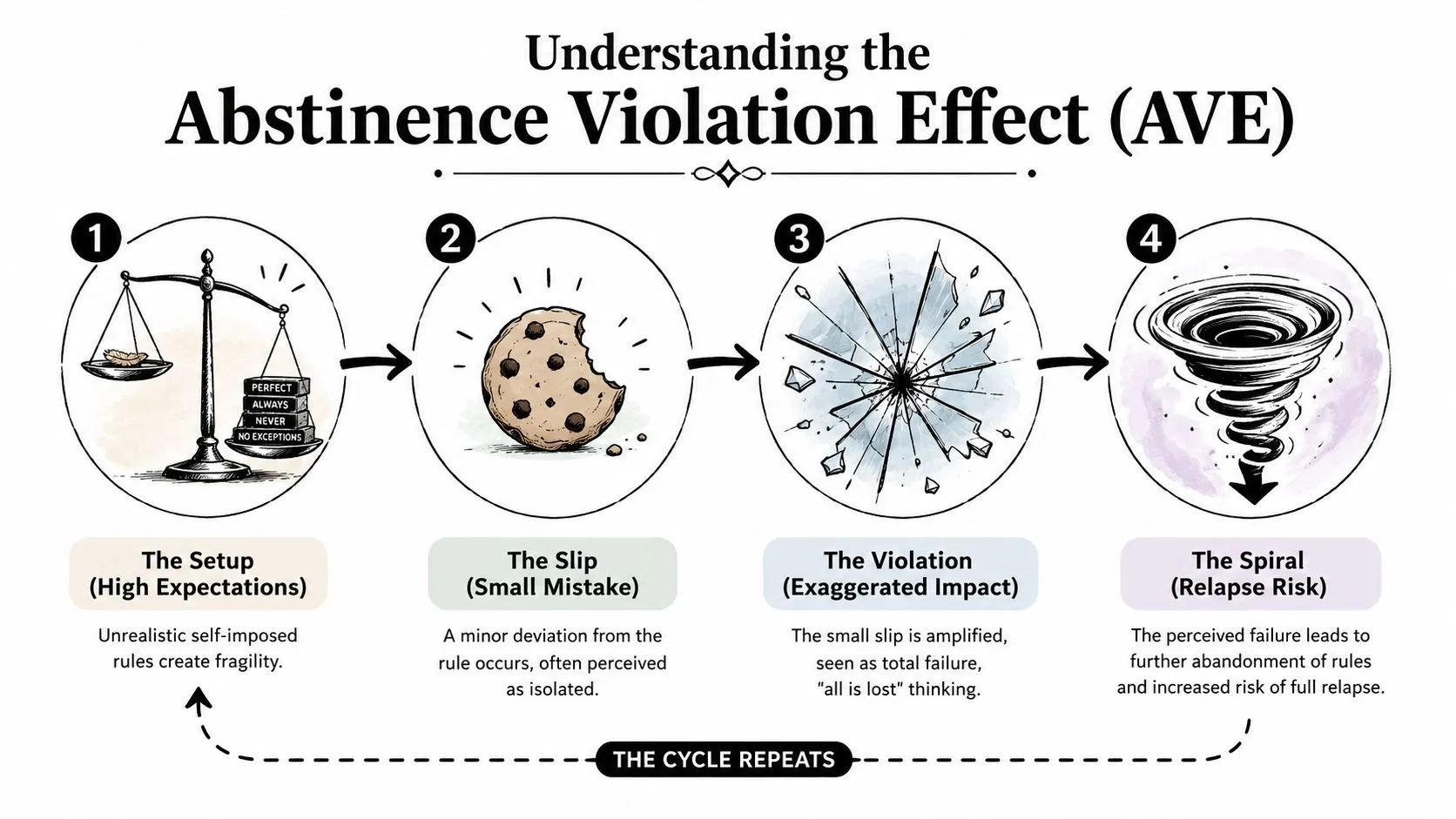
The basic cycle
AVE usually unfolds in a pattern like this:
-
Rigid rule
You tell yourself success means perfect abstinence with zero mistakes. -
Small lapse
You peek, click, search, fantasize longer than you intended, or fully act out. -
Harsh interpretation
The mind says, “I have no self-control. I’m back at square one.” -
Bigger relapse risk
Since the day feels ruined, you stop resisting and keep going.
This is why rigid standards can backfire. Standards matter. Structure matters. But when your whole recovery identity depends on a spotless record, one bad moment can feel like a total identity collapse.
Why guilt turns one mistake into many
Guilt can be useful when it leads to correction. Toxic guilt does something else. It says the lapse reveals who you are.
That’s the heart of AVE. It fuses behavior with identity. Instead of “I made a bad choice,” the mind says, “I am a failure.” Once that happens, acting out again can feel strangely logical. If you believe you already failed, more failure feels consistent.
That’s why willpower alone doesn’t solve this problem. You can be disciplined and still get trapped by distorted thinking. To break AVE, you have to challenge the meaning your mind assigns to the slip.
How the AVE Shows Up in Porn Recovery
Porn recovery has a special vulnerability to AVE. The behavior often happens in private, the shame is intense, and people tend to keep score with streaks. That combination can make a small lapse feel morally huge.

Research on relapse emphasizes that how a person interprets a lapse can affect what happens next. Treating one event as proof of permanent failure can increase shame and make a return to the old pattern more likely. That is why the inner dialogue after a slip matters so much.
What the spiral sounds like
Here’s what AVE often sounds like in porn recovery:
-
After a glance
“My streak is broken. So that’s over.” -
After a short slip
“I knew I couldn’t do this.” -
After the shame hits
“I’ve already messed up. I might as well get it out of my system.” -
After the binge starts
“I’ll restart tomorrow.”
This is the part many people miss. The binge usually isn’t driven by desire alone. It’s driven by despair, self-labeling, and the urge to escape the pain of self-condemnation.
What a healthier response sounds like
A healthier response sounds very different. It’s less dramatic and more honest.
- “I slipped.”
- “I need to stop this now.”
- “What triggered it?”
- “Who do I need to tell?”
- “What do I need to change tonight so this doesn’t continue?”
That response doesn’t excuse the behavior. It puts it in proportion.
In porn recovery, this can mean the difference between a brief interruption and a full weekend spiral. The key move is refusing to let one breach define the whole mission.
How to Prevent the AVE Spiral Before It Starts
Individuals often wait until after a slip to think clearly. That’s too late.
You need a plan before your brain gets flooded with urge, secrecy, and rationalization. Preventing the abstinence violation effect is less about being tougher and more about being prepared.
Redefine success before urges hit
If success means “I never make a mistake,” your recovery is fragile.
If success means “I respond fast, tell the truth, and keep building a different life,” your recovery gets sturdier. Perfection sounds noble, but in practice it often creates panic. Progress creates staying power.
A lot of this comes down to mindset and structure. The National Library of Medicine’s overview of relapse prevention describes recovery as a multi-component process rather than a single act of willpower.
Here are three definitions of success that help:
-
Fast interruption
You don’t pretend the urge isn’t there. You cut off the pattern early. -
Honest reporting
You tell the truth quickly, even when you’re embarrassed. -
Trigger learning
You ask what set the moment up instead of only asking what went wrong.
Build a high-urge plan you can follow half-asleep
A good high-urge plan should be short enough to use when your thinking is bad.
Write it down. Keep it on your phone. Don’t trust memory in the middle of temptation. A practical version might look like this:
| Moment | What to do |
|---|---|
| First strong urge | Put the phone down and stand up |
| Risk rising | Move to a public room or leave the bedroom |
| Mind starts bargaining | Text one person a prewritten message |
| Still agitated | Start a replacement action for ten minutes |
Use real replacement actions, not vague intentions. Walk outside. Shower. Do push-ups. Put on shoes and leave the house. Open a saved resource on how to overcome temptation. The point is to remove choice when your judgment gets foggy.
Train a less destructive inner voice
You don’t need cheesy affirmations. You need accurate self-talk.
Replace “If I slip, everything is ruined” with “If I slip, my next response matters most.” That sentence is simple, but it blocks the AVE chain before it picks up speed.
Your Action Plan for the Moment After a Slip
You close the tab, your stomach drops, and your mind starts talking fast. “I already messed up.” “The streak is gone.” “I may as well keep going.” That is the moment that decides whether a slip stays small or turns into a full relapse.
Your first job is simple. Interrupt the chain.
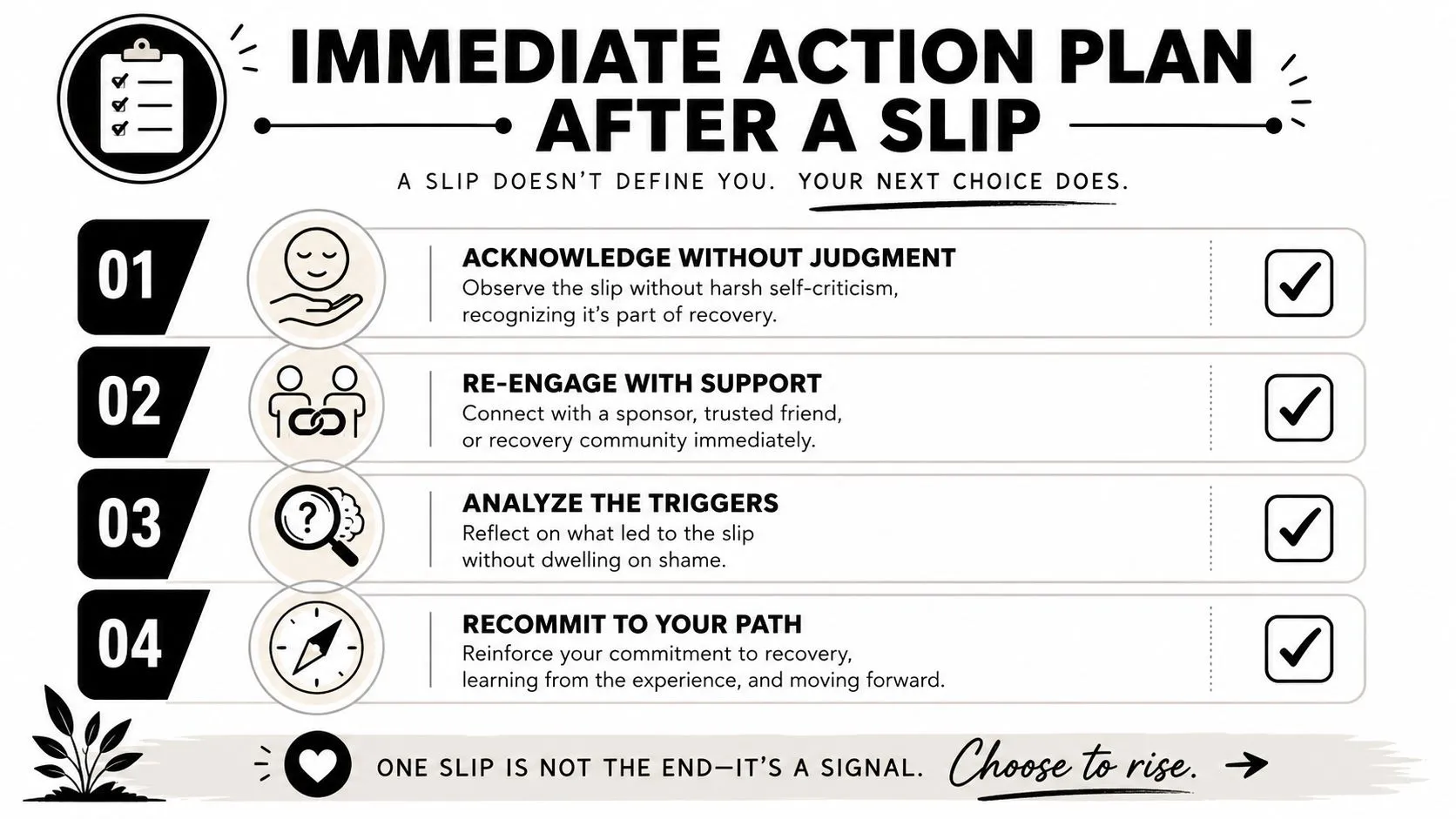
Step 1 Pause and cut off the spiral
Start with your body, not your analysis. Get out of the physical setup that supported the slip.
Stand up. Close the device. Leave the room. Put the phone where you cannot reach it without effort. Turn on the lights. Get around other people if possible. The goal is to make the next bad decision harder in the next sixty seconds, not to feel spiritually calm.
Then use one sentence that is plain and believable: “I slipped. I am stopping here.”
That wording matters. It keeps the event specific. AVE turns one lapse into a global verdict about your character, then uses that verdict to justify more acting out. A short, accurate statement breaks that logic.
Use this emergency checklist:
-
Change location
Go somewhere less private and less convenient for acting out. -
Reduce access
Shut the laptop, move the phone, block the app, or hand the device to someone else. -
Contain the next ten minutes
Get through a short window first. Long-range promises are weak when your brain is flooded.
Step 2 Answer the first toxic thought with RAP
After the physical reset, catch the thought that usually drives the binge: “I blew it.” “I’m back at zero.” “This proves nothing has changed.”
Use RAP. Realistic, Adaptive, Positive.
-
Realistic
“I made a choice I do not want to repeat. That is true. It does not erase the work I have already done.” -
Adaptive
“The next useful step is to stop, report it, and identify what set this up.” -
Positive
“I can recover well from this hour.”
RAP works because it does not ask you to fake confidence. It asks you to replace distorted thinking with thinking you can still act on while upset. In porn recovery, that trade-off matters. Grand statements often collapse under pressure. Plain statements hold.
If faith is part of your recovery, a grounded resource can help you shift from condemnation to action. These Bible verses after relapse for guilt, honesty, and getting back up fit well in this window.
Step 3 Communicate before your mind rewrites the story
Secrecy grows fast after a slip. So does bargaining. People tell themselves they will report it later, after they feel clearer, calmer, or less embarrassed. Later usually means after more damage.
Send the message while you still do not want to.
“I slipped today. I have stopped. I feel the pull to isolate, and I need a ten-minute check-in.”
Short beats polished. Honest beats impressive.
If you do not have an accountability rhythm yet, build one that makes quick contact normal. Regular structure and shared reflection can lower the odds that shame turns one mistake into a private spiral.
This video can help reinforce that mindset in the moment.
Step 4 Write down the setup in two lines
Once the urge drops a little, capture the pattern while it is still fresh. Keep it brief.
Write:
- What happened right before the slip.
- What you need to change before tonight.
Example: “Stayed up scrolling in bed after an argument. Phone charges in the kitchen tonight.”
This is how you turn a lapse into data instead of drama. Shame asks, “What is wrong with me?” Recovery asks, “What conditions made this easier, and what will I change now?”
Using Recovery Tools to Beat the AVE
Good recovery tools don’t just track behavior. They shape your response to hard moments.
That matters because some tools help you stay honest, while others feed the abstinence violation effect. A tracker can motivate you, but if you use it like a moral scoreboard, one broken streak can trigger the same old collapse.
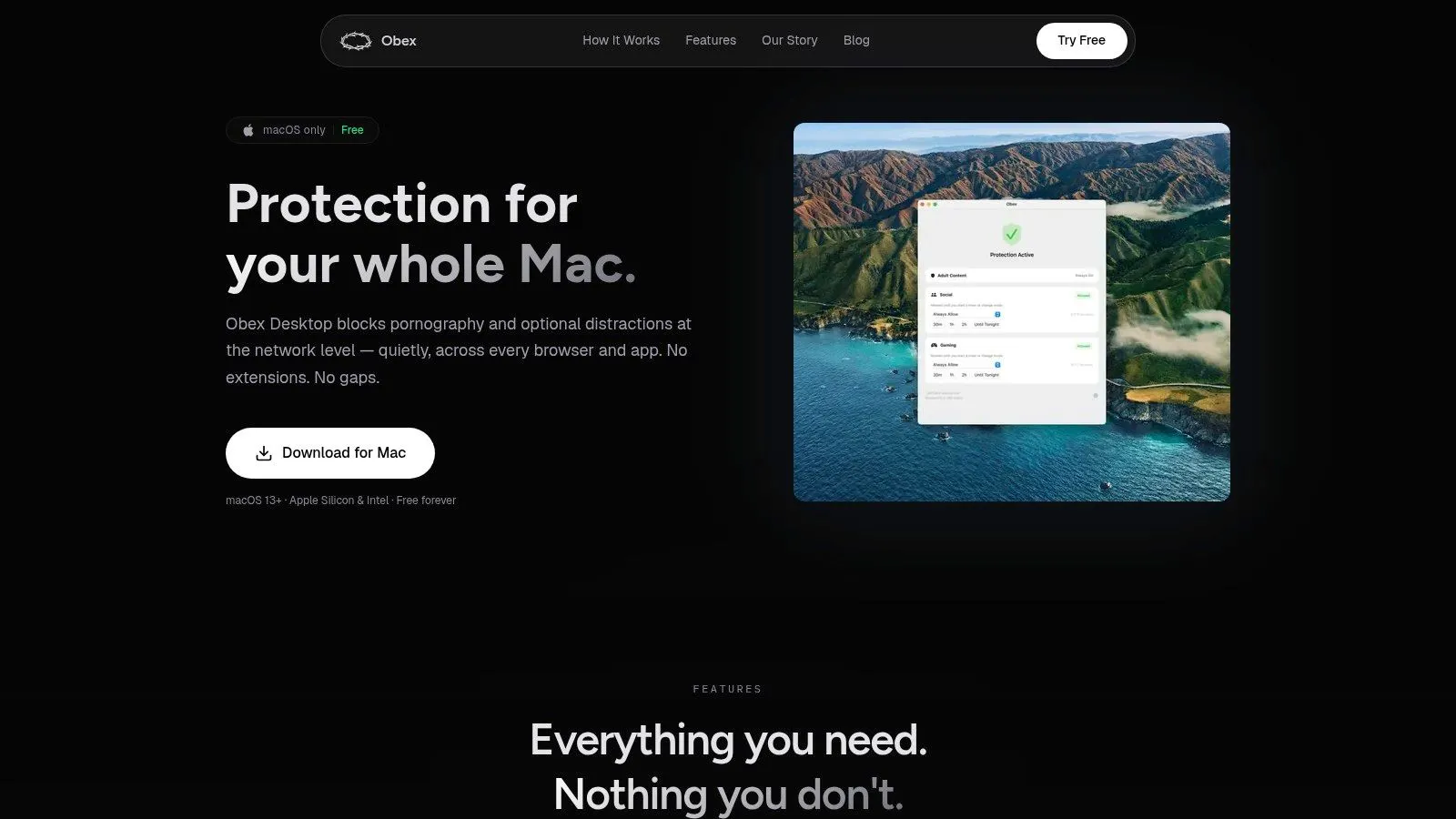
What tools actually help
The best tools make three things easier. Fast interruption, honest accountability, and trigger review.
That can include device barriers, check-in systems, journaling prompts, and quick-access emergency actions. In group settings, regular reflection and shared structure can make it easier to re-engage quickly after a lapse.
Useful recovery tools usually have these traits:
-
They reduce delay
You can get help fast instead of debating with yourself for half an hour. -
They make honesty simpler
The path to check in is obvious and low friction. -
They support review
You can look at patterns without turning the data into self-hate.
If you’re building an accountability system, this article on why accountability works better than white-knuckling gets at the core issue. Private willpower often collapses under shame. Shared structure holds up better.
What tools can accidentally make AVE worse
Not every “recovery” tool helps.
Some people collect blockers, trackers, and motivational content but still use them with a perfectionist mindset. Then the tool becomes another judge. If they slip, they avoid the app, ignore messages, and disappear from support.
That’s why the tool itself isn’t the answer. The way you use it matters. A solid system should treat a lapse as signal, not as identity. It should help you re-engage quickly, not push you into hiding.
Frequently Asked Questions About Slips and Relapses

Does one slip erase all progress
No. In porn recovery, one lapse can expose a weak point in your plan, but it does not wipe out every hour of honesty, restraint, and skill-building that came before it.
What turns a slip into real trouble is the meaning attached to it. If you tell yourself, “I blew it, so I’m back at zero,” the mind often follows that story with more acting out, more hiding, and less willingness to re-engage. A 1994 study of 75 adult marijuana users found that people who explained a lapse as proof of a personal, lasting weakness were more likely to relapse afterward. The mechanism is highly relevant here. Shame-based explanations make the next bad choice easier.
Progress in recovery is better measured by what happens next. Did you interrupt the pattern quickly? Did you tell the truth? Did you review the trigger and adjust your plan? Those are recovery actions.
What is the difference between a slip and a relapse
A slip is a short break in the plan. A relapse is a return to the old cycle.
In porn recovery, that difference is usually practical, not philosophical. A slip may mean a brief lapse in behavior followed by fast honesty, damage control, and a return to structure. A relapse usually includes repetition, secrecy, rationalizing, and giving up on the recovery response.
Labels matter less than response speed.
If someone slips at night, deletes evidence, stays up binging, and avoids support the next day, that pattern is already moving toward relapse. If someone slips, shuts the screen, sends the check-in, and reviews what set it off, recovery is still active. Our porn relapse guide explains that response process in more detail.
How do I explain AVE to my spouse or accountability partner
Use plain language.
You can say, “The abstinence violation effect is what happens when I treat one lapse like total failure, then that shame makes me more likely to keep going.” That explanation usually lands because people have seen the same pattern in eating, spending, anger, and other habits.
Then be specific about what helps. Ask them to respond with steadiness, not panic. Ask them to help you slow the moment down, name what happened clearly, and look at the trigger, the story in your head, and the next protective step. In porn recovery, that kind of response lowers the odds of a one-time lapse turning into a binge fueled by hopelessness.
The point isn’t to excuse the behavior. The point is to stop one bad moment from becoming five worse ones.
If you want more structure for porn recovery, Obex gives you a practical system for streak tracking, accountability, high-urge support, and daily momentum. Used well, tools like that can help you respond to lapses faster, reduce secrecy, and keep one mistake from turning into a full spiral.