PMO Meaning: Porn, Masturbation, Orgasm & How to Quit
PMO means porn, masturbation, orgasm. Learn how the PMO cycle becomes compulsive, how it differs from porn addiction and NoFap, and how to break it.


Obex
Obex Team
PMO stands for porn, masturbation, orgasm. In NoFap and porn-recovery communities, the term names the whole sequence, from opening porn to the orgasm that reinforces the habit, so you look at it as one thing instead of three unrelated steps.
If you’ve spent any time around NoFap or porn-recovery spaces, you’ve seen people say stuff like “I relapsed into PMO” or “trying to quit PMO for 90 days”.
It isn’t a medical diagnosis. People use it as practical shorthand that helps you see the whole loop and interrupt it earlier.
What PMO means in plain language
PMO describes a sequence:
- Porn starts the stimulation
- Masturbation becomes the behavior
- Orgasm closes the loop and reinforces it
People use the term because these three usually come together, and the issue is usually the repeated pattern more than one isolated act.
If you only think “my problem is porn”, you can miss everything that happens before the full relapse:
- browsing
- fantasizing
- edging
- searching
- “just checking” social media or other triggers
Looking at it as PMO puts the whole sequence in front of you way sooner.
Why recovery communities say PMO instead of just porn
“Porn” on its own is often too narrow. For a lot of guys, seeing sexual content is only the start, and the bigger trap is a familiar loop they run whenever they need to feel better:
- stress hits
- boredom hits
- loneliness hits
- you look for quick relief
- porn becomes the way in
- the full session takes over
If you only name the porn, you can still lie to yourself about the rest, and that’s where the excuses creep in:
- “I only looked.”
- “I didn’t finish.”
- “It was only fantasy.”
- “I was just edging.”
PMO cuts through some of that, because it reminds you that the habit usually moves as one thing, start to finish.
When the loop turns into long edging, escalating content and hours of checking out, people often call it gooning.
How the PMO cycle actually works
The cycle itself is simple, it just gets repeated so many times that it stops feeling optional.
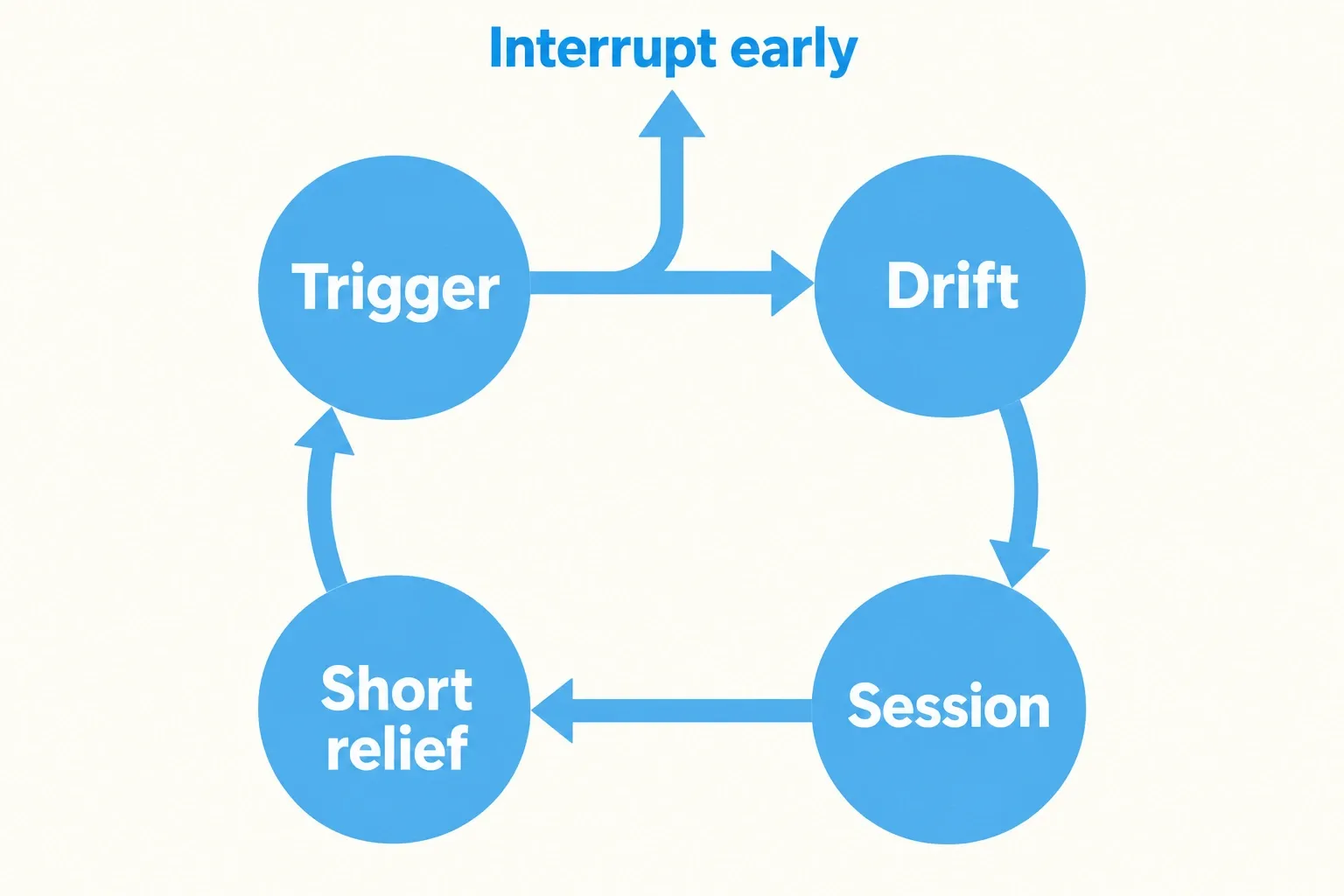
It usually goes like this:
- a trigger shows up
- you drift toward stimulation
- the drift becomes a session
- orgasm gives you some short-term relief or release
- shame, numbness, exhaustion or emptiness hits afterward
- later, another trigger starts the loop again
That’s how PMO turns compulsive. Overwhelming sexual desire is only part of what drives it, and a lot of the time it’s driven by needing to feel better:
- stress relief
- boredom relief
- escape
- self-soothing
- procrastination
- dealing with loneliness
The arousal part is real, but the coping part is often what keeps the habit alive.
What PMO addiction usually looks like
Not everybody who watches porn or masturbates has a PMO addiction.
When people do say PMO addiction, they usually mean the loop has become hard to control even though it’s clearly hurting their life. Common signs:
- you keep going back after deciding to stop
- sessions are getting longer or more frequent
- the content escalates because normal material stops feeling strong enough
- real intimacy starts feeling weaker than the screen
- PMO is your default response to stress, boredom or shame
- your sleep, work, focus or relationships are taking damage
Having urges doesn’t mean much on its own. The clearest sign is that the loop keeps taking over even after you’ve decided you want to stop.
That’s why a lot of recovery writing treats PMO as a habit system more than a random moral slip.
Why the orgasm part matters
Some people ask why the “O” is in there at all. The way recovery communities usually explain it, orgasm is the reward at the end that closes the loop and makes the habit stickier, basically teaching you “this works, do it again”.
That doesn’t mean orgasm is automatically the enemy in every context. Inside a compulsive porn loop, though, it works as the reward that keeps the behavior going.
This is a big reason edging is such a bad bargain, because it keeps the loop running while you argue that you didn’t fully finish. Is edging bad for you goes into that directly.
PMO vs porn addiction, NoFap, and hard mode
These terms overlap, but they mean different things:
- PMO is the behavior loop: porn, masturbation, orgasm.
- Porn addiction usually means the broader compulsive pattern around porn use and the behaviors tied to it. It isn’t a formal diagnosis either; the closest official one is compulsive sexual behaviour disorder in the WHO’s ICD-11.
- NoFap is the recovery framework or challenge people use to break the loop.
- Hard mode means no porn, no masturbation, and no orgasm at all for a set period, even with a partner. If you’re comparing approaches, NoFap hard mode is its own thing.
- Semen retention is different again. It’s usually framed around not ejaculating, often for spiritual or discipline reasons, more than around addiction recovery.
People mix them up because they overlap so much in practice, but keeping them separate makes it a lot easier to think clearly about what you’re doing.
Why the PMO frame is useful in recovery
It helps you fight the battle earlier.
Most guys lose because they wait until the urge is fully lit and the session is already underway, and that’s the worst place to try to be rational. Thinking in terms of PMO helps you notice:
- the trigger
- the drift
- the environment
- the ritual before the relapse
That’s where you have the most leverage. If you can catch the loop when it’s still at “I’m alone, tired and scrolling”, you have a real shot at interrupting it. If you only count the final orgasm as the problem, you’re usually stepping in too late.
Because PMO is a loop, the easiest place to break it is the front end, before the whole chain gets going.
What usually triggers PMO
The strongest triggers often aren’t sexual at first. Common ones:
- being alone late at night
- stress after work or an argument
- boredom
- shame after a previous slip
- rejection or loneliness
- drifting on social media
- procrastinating
- certain rooms, devices or times of day
That’s why trigger mapping matters so much. A lot of guys think their relapse “just happened” when it really followed the same setup it always does.
How to break the PMO cycle
Most guys try to fight PMO in the middle, which usually means gritting their teeth through an urge after they’ve already opened the wrong tab, started fantasizing, or slid into the old routine. Here’s what works better.
1. Catch the start, not just the finish
Notice the first drift:
- opening risky apps
- scrolling in bed
- isolating after stress
- telling yourself you’re “just checking”
The earlier you catch it, the easier it is to stop.
2. Slow down access
Make the loop harder to run:
- move devices out of the room
- block the obvious sites
- stop bringing the phone into bed
- change the time and place where you usually act out
None of it’s complicated, you’re just making the easy path a bit harder.
3. Replace the danger-window routine
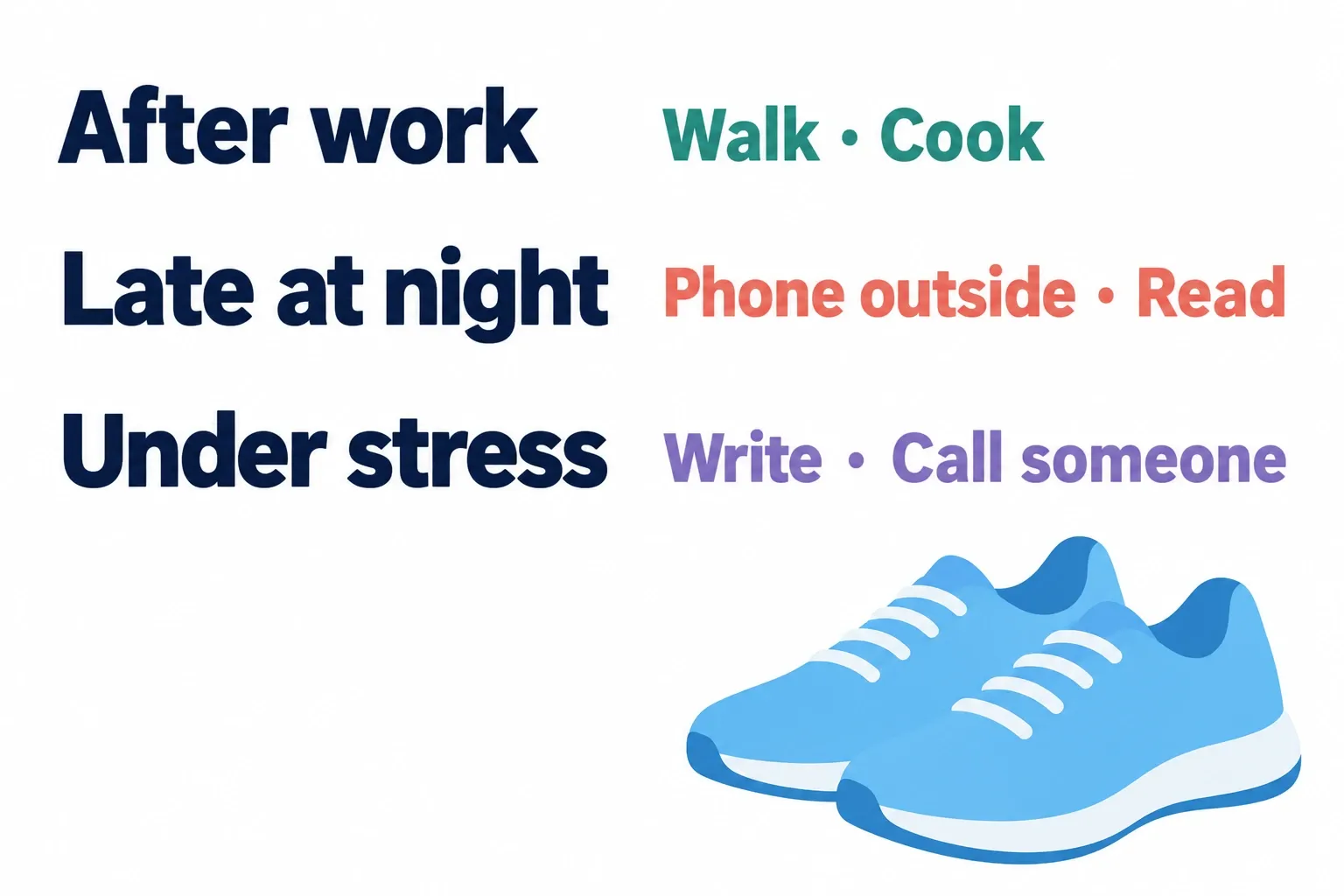
If PMO usually happens in the same windows, those windows need a new script. For example:
- after work: walk, shower, cook, call someone
- late at night: charge your phone outside the room, read, sleep
- stress spike: journal, breathe, text your accountability partner, go outside
Pick something you’ll actually do at 11pm, even if it’s small.
4. Use accountability if secrecy is part of the loop
PMO grows in private, which is why accountability works better than going it alone for a lot of guys. Someone else knowing breaks the closed circle of urge, secrecy and autopilot, and it doesn’t need to turn into surveillance.
5. Review near-misses too
Don’t only look back at full relapses. If you drifted, hovered or nearly acted out, that’s still useful, because it shows you where the loop starts and what still worked.
Does PMO always mean addiction?
No. PMO is a descriptive term, not automatically a diagnosis. Some people just use it to describe the behavior, and others use it because the behavior has gotten compulsive enough to feel like an addiction.
The pattern is worth more of your attention than the label. If you keep doing something that:
- feels hard to stop
- keeps violating your own standards
- damages your focus, sleep or relationships
- gets more secretive over time
then what you call it matters a lot less than the fact that the loop is running your life.
The bottom line
PMO means porn, masturbation, orgasm, and people use the term because it names the whole cycle instead of only the most obvious part of it. That makes it practical: it helps you spot the habit earlier, talk about it more clearly, and stop pretending the problem only starts at the last moment.
If you want to break the pattern, think about the whole loop, from the first drift to the end.
Frequently asked questions
What does PMO mean sexually?
It means porn, masturbation, orgasm. In recovery spaces it usually refers to the whole loop more than any one action.
Is PMO the same as porn addiction?
Not exactly. PMO is the sequence, the behavior pattern. Porn addiction usually means that pattern has become compulsive and hard to control, though it isn’t a formal diagnosis.
Does edging count as PMO?
In practical recovery terms, yes, it usually belongs to the same loop, especially if porn or fantasy is involved. Treating it like a harmless exception usually backfires.
Can you do NoFap and still have sex?
Yes. In standard NoFap, a lot of people separate quitting the PMO loop from having sex with their wife. If you’re married, that’s the version we’d point you to, because you’re fasting from porn, not from your wife (more on hard mode).
Why do people track PMO separately?
Because it makes the excuses harder. Tracking the whole loop helps you see the pattern earlier, instead of pretending “just looking” didn’t count.
If you want something to reach for at the front end of the loop, Obex has a Panic Mode with tools and Scripture for the moment an urge starts.