Canopy vs Covenant Eyes: Filtering, Accountability, and Price
Canopy or Covenant Eyes? Which one blocks better, which keeps a real person in the loop, how each handles privacy, and what they cost right now.

Obex
Obex Team
If you’re trying to decide what to put on your phone and laptop, Canopy and Covenant Eyes are probably the two names you keep running into. They both put friction between you and porn, but they go about it in pretty different ways.
- Canopy is filtering-first. AI checks images, video and text as they load and removes anything explicit before it reaches your screen, with app and website blocking and removal prevention on top.
- Covenant Eyes is accountability-first. Its Victory Shield app takes blurred screenshots, has AI check them for explicit content, and shares the results with an ally. Blocking explicit websites is included as an option.
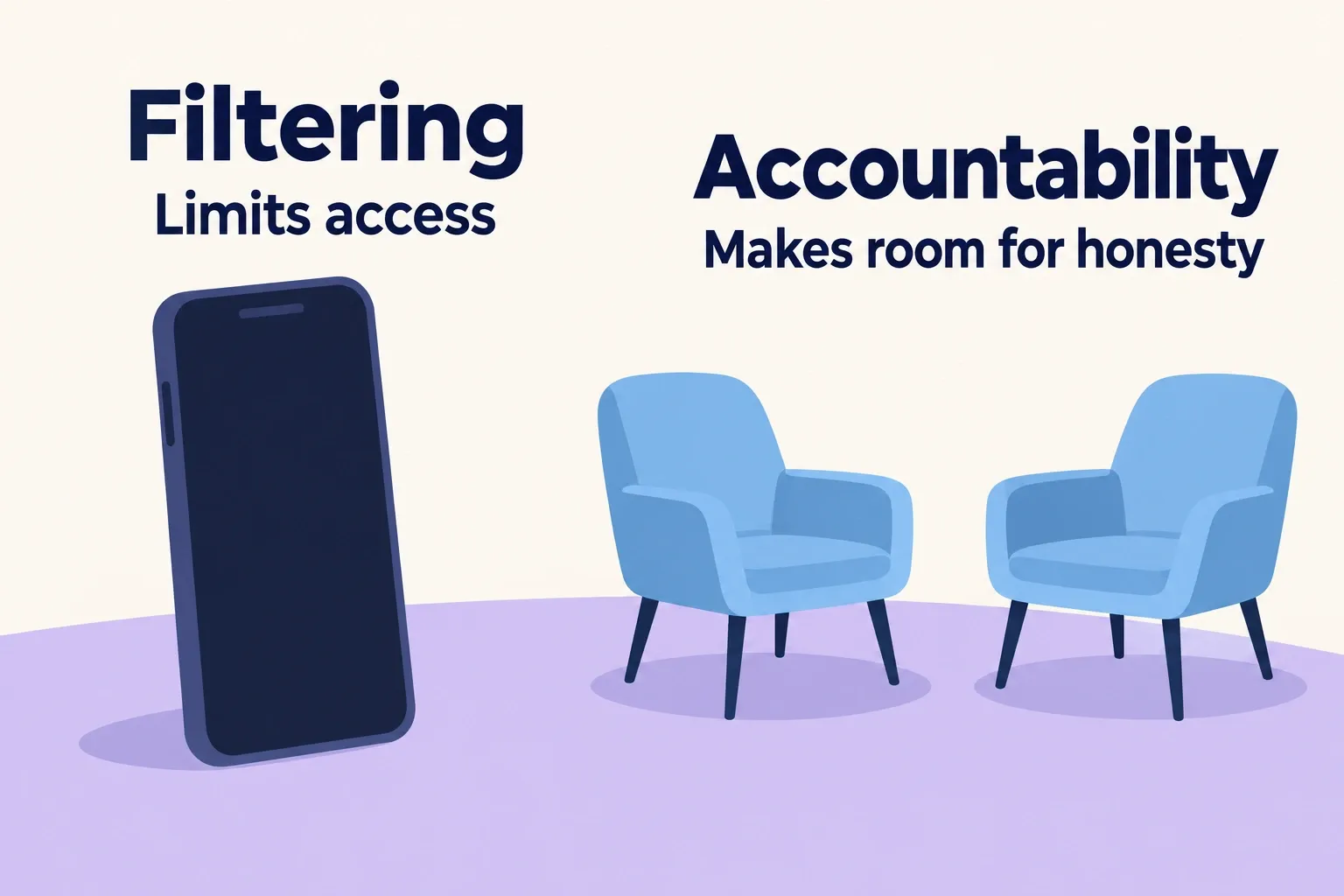
Both have an accountability partner now, so the old shorthand, “Canopy blocks, Covenant Eyes reports,” isn’t completely accurate anymore. What you’re really choosing is which layer you want to be strongest. So here’s the quick verdict, a side-by-side table, how each one works, what they cost, and how to choose. If you’ve already ruled out Covenant Eyes, Covenant Eyes alternatives covers Canopy next to four other options.
Full disclosure: this is the Obex blog. Obex is a Christian recovery app with its own blocker, so we compete with both of these in some ways. Everything below about Canopy and Covenant Eyes comes from their own websites, help centers and app store listings, as of October 2026.
Quick verdict
If blocking explicit images and sites across your devices matters most, pick Canopy, and set up a partner, either a person you invite or Canopy’s AI Ally, so that lowering your protection needs their approval.
If secrecy is the bigger problem and you want a trusted ally who sees your activity and talks to you about it, pick Covenant Eyes, and turn on its blocking as an extra layer.
Neither one figures out your triggers or changes your routines for you, and neither replaces professional help if things have gotten severe.
Canopy vs Covenant Eyes at a glance
| Category | Canopy | Covenant Eyes |
|---|---|---|
| Main approach | Real-time content filtering | Screenshot accountability |
| Porn blocking | Core feature: filters images, video and text as they load, blocks sites | Optional: blocks explicit websites, with your own block and allow list |
| Accountability | A person or AI Ally approves requests to lower your protection and hears about blocked attempts | An ally sees blurred screenshots, an activity feed, alerts and check-ins |
| Screenshots | None | Blurred, at least once a minute (on an iPhone, only in Safari) |
| Devices | iPhone, iPad, Android, Mac, Windows (not ARM), Chromebook | iPhone, iPad, Android, Mac, Windows |
| Website price | $8.33 to $12.50 a month, billed yearly, for 1 to 10 devices | $18 a month, $198 a year or $950 lifetime, unlimited devices for up to 10 people |
| Best fit | A strong barrier in your environment | A strong accountability relationship |
Prices come from Canopy’s pricing page and Covenant Eyes’ Victory page, as of October 2026.
How Covenant Eyes works
Covenant Eyes’ service is called Victory, and it has two parts (Covenant Eyes FAQ):
- Victory Shield runs on each device. It takes a screenshot at least once a minute, has AI check it for explicit content, blurs it before it leaves your device, and can block explicit websites (how monitoring works).
- The Victory app is where you and your ally see the activity feed, get alerts and check-ins, message each other and use the learning courses.
That makes Covenant Eyes relationship-first. The software matters, but most of its value comes from choosing an ally who’ll pay attention and respond. The Covenant Eyes review goes into what your ally sees in more detail.
What Covenant Eyes does well
- It’s built around one trusted person, who gets an alert about a minute after something explicit is caught
- Screenshot checks can catch things a website block misses (on an iPhone, only in Safari)
- Blocking is included, so you don’t need a second subscription for it
- One plan covers unlimited devices for up to 10 people in a family
- Learning courses, a Christian community and programs for churches are part of the service
Where Covenant Eyes falls short
- It gets a lot weaker if your ally ignores the feed or avoids hard conversations
- Even blurred, a steady stream of screenshots going to another person is a real privacy tradeoff
- It costs more: $198 a year on the website, against roughly $100 to $150 for Canopy’s yearly plans
- On an iPhone it can’t screenshot other browsers or apps, only Safari
- It doesn’t work on Chromebooks
It’s best for someone who already has a dependable ally, or is ready to pick one, and wants technology that keeps that relationship going.
How Canopy works
Canopy is built to detect and filter explicit content before it reaches your screen (how Canopy works). It looks at the images, video and text on a page as it loads and removes the explicit parts, so a site like Instagram can stay usable, and it also blocks known porn sites and any apps or sites you choose (Canopy for adults). Every plan includes removal prevention, focus tools and an accountability partner feature.
The partner feature works differently from Covenant Eyes. You either invite a person, who gets a text or email when you try to lower your protection or hit blocked content and can approve or deny changes without installing anything, or you turn on AI Ally, which does the same job and talks the request through with you (Canopy’s Ally page). Nobody gets a report of your browsing.
What Canopy does well
- Real-time filtering is the main product
- Works on iPhone, iPad, Android, Mac, Windows and Chromebook
- Removal prevention adds friction when you’re tempted to get around it on impulse
- Your partner doesn’t need an app, and AI Ally is there if you’re not ready to tell anyone yet
- Its yearly plans cost less than Covenant Eyes’
Where Canopy falls short
- No filter is impossible to get around, especially with an unprotected device nearby
- Protection works a bit differently on each operating system
- Your partner sees requests and blocked attempts, not your activity, so it does less about secrecy
- It’s a filter, and Canopy itself says it isn’t therapy or a cure
It’s best for someone who wants the strongest barrier in their environment first and a simpler, approval-based accountability layer second.
Pricing compared
As of October 2026:
- Canopy Essential: one device, $8.33 a month billed yearly on the website. In the App Store, the one-device plan is $9.99 a month or $99.99 a year.
- Canopy Plus: up to three devices, $9.99 a month billed yearly, or $15.99 a month or $119.99 a year in the App Store.
- Canopy Premium: up to 10 devices, $12.50 a month billed yearly, or $19.99 a month or $149.99 a year in the App Store (Canopy on the App Store).
- Covenant Eyes Victory: $18 a month, $198 a year, or $950 for a lifetime membership on the website, covering unlimited devices for up to 10 people. Through the App Store or Google Play it’s $19.99 a month or $219.99 a year (Covenant Eyes help center).
Canopy has a 7-day free trial and a 30-day money-back guarantee. Covenant Eyes has a 30-day money-back guarantee on website purchases only, and a 7-day free trial if you sign up in its app. Both can show different prices depending on where you buy, promotions and sales tax, so check the price at checkout.
Which one should you choose?
Choose Canopy when blocking is the priority
Canopy makes more sense when the problem right now is how easy it is to get to. If explicit stuff keeps showing up through browsing, social feeds or just unstructured time on your devices, filtering gives you a pause before it goes any further.
Choose Covenant Eyes when secrecy is the priority
Covenant Eyes makes more sense when secrecy is the main problem. A trusted ally who gets useful signals and follows up can interrupt the private reasoning (“it’s fine, nobody will know”) that often comes right before a relapse.
Consider both when the pattern is severe
Some people do better with a filtering-first product plus a separate recovery and accountability system. If your current setup keeps failing, having two layers is pretty reasonable.
What neither tool does for you
Filtering and monitoring deal with access and visibility. They don’t change the emotional triggers, avoidance patterns or isolation underneath the behavior on their own.
They also don’t replace:
- a plan for your high-risk times and devices
- honest conversations with a partner, mentor, therapist or group
- something to do in the first few minutes of an urge (many people find urges ease within about 10–15 minutes of doing something else)
- sleep, exercise and routines that make you less vulnerable
- treatment from a qualified professional when porn use is causing serious distress or impairment
Before you buy either, think about your last few slips. If they happened because it was easy to get to, start with Canopy. If they happened because nobody would ever know, start with Covenant Eyes.

If you need a broader setup, read how to block porn on your computer.
If what’s missing is a plan for the moment an urge hits and people to be honest with, Obex puts Panic Mode, daily check-ins and a Christian community with accountability in one iPhone app, along with blocking for the apps and sites you choose. It needs an Obex Pro subscription ($6.99 a week, $11.99 a month or $39.99 a year).