Bible Verses About Shame and Guilt After Sexual Sin

Obex Team
Updated · 10 min read

You fell again, and now you kind of feel disgusting. Praying feels fake, so you skip it for a day or two, and when you do come back it’s with bigger promises than last time and a bit less honesty about what happened.
That loop is really common for Christians fighting porn, lust or masturbation, and from the outside it can even look spiritual. Underneath, though, shame is running it, and shame rarely leads to steady change. Mostly it leads to hiding, overpromising, exhaustion and, pretty often, another fall.
Bible verses about shame and guilt draw a clearer line than that. Guilt, or conviction, is healthy when it tells you the truth about sin and moves you toward confession. Shame is what happens when the failure turns into who you are and keeps you in the dark. So this post goes through the verses that help you tell the two apart, what to do in the first hour after a relapse, and what to do when the shame hangs around for days. Quotations are from the World English Bible, which is in the public domain.
How to tell guilt from shame (2 Corinthians 7:10)

— 2 Corinthians 7:10For godly sorrow produces repentance leading to salvation, which brings no regret. But the sorrow of the world produces death.
This is the clearest test in the Bible for telling guilt and shame apart.
Godly sorrow goes somewhere: confession, telling the truth, making things right, changing what you do. Worldly sorrow stays stuck on how awful everything feels, and nothing good comes out of it.
Peter is the first kind. After he denied Jesus three times, “the Lord turned and looked at Peter,” and Peter “went out, and wept bitterly” (Luke 22:61–62). His grief was real, and it sent him back toward Jesus instead of away from him. Two days later he was running to the empty tomb (John 20:3–6), and after the resurrection Jesus restored him by the lake with three questions to match the three denials (John 21:15–17).
After a fall, ask yourself:
- Is this grief making you more honest, or more hidden?
- Are you confessing plainly, or just going over how much you hate yourself?
- Is anything changing, or are you only punishing yourself?
If your guilt leads you to tell the truth, set boundaries and come back to God, it’s doing its job. If it leads you to disappear, binge, or decide that praying would be hypocritical, shame has taken over, and the hour right after a relapse is usually where that happens.
Right after a relapse: the first hour
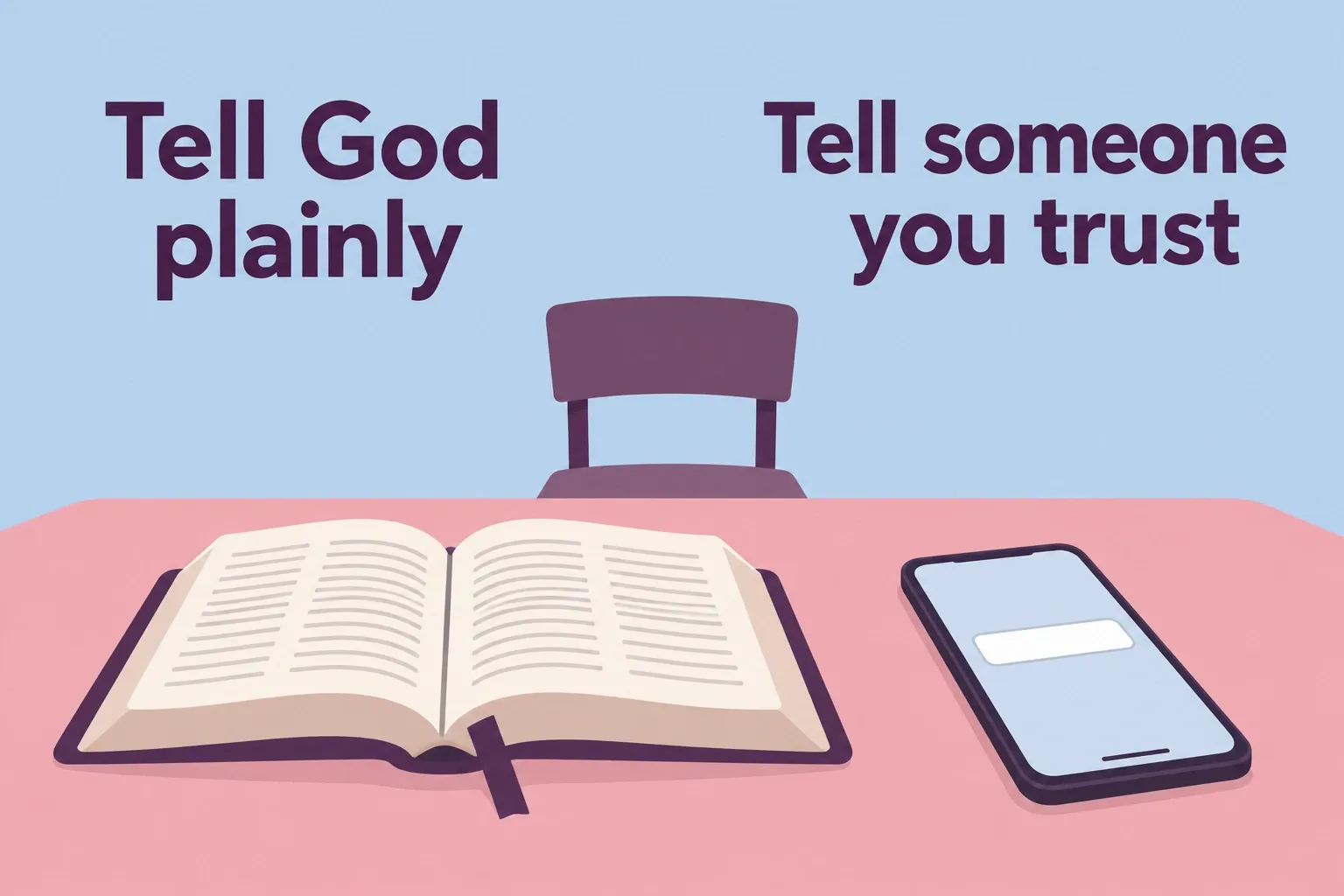
The hour after a relapse is when shame works fastest. It’s also when one fall most easily turns into a binge, a lost weekend, or a week of avoiding God.
The first thing Adam and Eve did after they sinned was cover up and hide, and the first thing God did was come looking for them:
— Genesis 3:8-9They heard Yahweh God’s voice walking in the garden in the cool of the day, and the man and his wife hid themselves from the presence of Yahweh God among the trees of the garden. Yahweh God called to the man, and said to him, “Where are you?”
That question still deserves an honest answer, and these are the verses worth having open while you give it.
— 1 John 2:1My little children, I write these things to you so that you may not sin. If anyone sins, we have a Counselor with the Father, Jesus Christ, the righteous.
John wrote this to believers, and the second half is for after you’ve failed. “If anyone sins” assumes it’s going to happen to people who belong to Christ, and Jesus is already speaking for you before you’ve figured out what to say.
— Micah 7:8Don’t rejoice against me, my enemy. When I fall, I will arise. When I sit in darkness, Yahweh will be a light to me.
Micah says when I fall, and in the same breath says he’ll get back up. Sitting in darkness is a pretty fair description of the hour after a relapse, and in this verse the darkness is where God shows up as light.
— Proverbs 24:16for a righteous man falls seven times and rises up again, but the wicked are overthrown by calamity.
Both people in this proverb fall, and the difference is that one of them gets back up. That doesn’t make falling okay, but it does show you what faithfulness looks like the morning after.
— Psalm 51:10-12Create in me a clean heart, O God. Renew a right spirit within me. Don’t throw me from your presence, and don’t take your Holy Spirit from me. Restore to me the joy of your salvation. Uphold me with a willing spirit.
If you don’t have words, borrow David’s. He wrote this psalm after his own sexual sin, and there’s no bargaining in it and no big vows. He asks God to make him clean and give him a willing spirit, and that’s pretty much it.
What to do in the next hour
This is for tonight. The bigger look back can wait until tomorrow, and what to do in the 24 hours after a porn relapse walks through that.
- Close it down. Shut the tab, put the device in another room, and get out of the bedroom if that’s where it happened. Staying where you are is how one relapse turns into three.
- Tell God plainly. Say what happened in a sentence or two. You don’t have to feel sorry enough first, because 1 John 1:9 ties forgiveness to confessing, and it says nothing about getting the emotions right.
- Text your accountability partner. Something short is enough: “I fell tonight. Can we talk tomorrow?” Send it within the hour, because the longer you wait, the harder it gets to send.
- Write down the setup while it’s fresh. Time, place, device, mood, and what you were doing in the hour before. You’ll use it tomorrow to figure out what to change, so keep it factual and leave out the commentary about yourself.
- Close one door before you sleep. Delete the app, log out of the account, or move the charger out of the bedroom.
- Go to bed. Skip the dramatic vow and the self-punishment, and keep tomorrow’s normal routine, prayer and church included. Shame will tell you you’ve lost the right to those, and that just isn’t true.
A relapse doesn’t erase your progress, and what you do next matters more than the number on the counter.
If the shame after a relapse ever turns into thoughts of hurting yourself, call or text 988 in the US, or your local crisis line, right away. Reaching out at that point is the right next step, and it doesn’t mean your faith has failed.
Once you’re through that first night, these are the verses for the days after, when shame keeps telling you that you’re still the thing you did.
What “no condemnation” means (Romans 8:1)
— Romans 8:1There is therefore now no condemnation to those who are in Christ Jesus, who don’t walk according to the flesh, but according to the Spirit.
People quote this one a lot, and it often gets misunderstood.
“No condemnation” doesn’t make sin trivial. What Paul is saying is that if you’re in Christ, guilt doesn’t get to be the final verdict on who you are.
Condemnation says you failed, so now that’s what you are: filthy, fake and hopeless. Conviction says you sinned, so bring it into the light, come back, and walk by the Spirit.
People get Romans 8:1 wrong in two ways. Some use it to shrug off sexual sin, even though Paul contrasts walking by the flesh with walking by the Spirit in the same sentence. Others believe the verse on paper and still live like staying crushed proves they’re serious, when usually it just means they’re stuck.
You need this verse because shame makes honest confession feel impossible, and Romans 8:1 tells you that coming into the light won’t destroy you.
Where God puts your forgiven sin (Psalm 103:11–12)
— Psalm 103:11-12For as the heavens are high above the earth, so great is his loving kindness toward those who fear him. As far as the east is from the west, so far has he removed our transgressions from us.
Shame keeps replaying the sin, and this psalm says God has already dealt with it.
The psalm is honest that the transgressions were real, and it says God removed them, as far as east is from west. Shame keeps dragging them back into the room and making them the first thing you see whenever you think about yourself.
That’s why shame takes over so much. It makes your failure the most important fact about you, even after you’ve confessed it. That can feel like humility, but it’s closer to being fixated on yourself, because God has said what he did with that sin and shame refuses to agree with him.
Some Christians honestly prefer shame because it feels safer than mercy. The thinking is that if they stay hard on themselves, they’re less likely to fall again. In practice, constant self-accusation tends to leave people weaker, more secretive, and quicker to reach for relief.
Psalm 103 is asking you to let a sin God already forgave stop running your life, and that doesn’t require forgetting it or pretending it didn’t happen.
Say what you did, to God and to one person (1 John 1:9, James 5:16)
— 1 John 1:9If we confess our sins, he is faithful and righteous to forgive us the sins and to cleanse us from all unrighteousness.
Shame talks in big foggy statements like “I’m disgusting”, and it makes everything about who you are. Confession is way more specific. It’s “here’s what I did”, said to God, and then you take his forgiveness on his terms, whatever your feelings are saying.
— James 5:16Confess your sins to one another and pray for one another, that you may be healed. The insistent prayer of a righteous person is powerfully effective.
James adds the part most ashamed people resist, which is another person.
Shame does best when nobody knows. “I already talked to God” can turn into a way to avoid the harder thing, which is telling someone who can ask follow-up questions and help you change the setup. Proverbs is blunt about where hiding leads: “He who conceals his sins doesn’t prosper, but whoever confesses and renounces them finds mercy” (Proverbs 28:13).
With sexual sin especially, telling someone ends the idea that you can fix this entirely inside your own head.
When shame hangs on for days
Sometimes the confession is done and the feeling stays. You told God, you told your friend, you changed the setup, and three days later you still feel filthy.
— Psalm 32:5I acknowledged my sin to you. I didn’t hide my iniquity. I said, I will confess my transgressions to Yahweh, and you forgave the iniquity of my sin.
The verses right before it describe what staying silent did to David: his bones “wasted away” and God’s hand was “heavy” on him (Psalm 32:3–4). Then he confessed, and the verse ends in the past tense: you forgave. If you’ve confessed, that’s where you stand, whatever your feelings are telling you.
A few things help when shame hangs around:
- Answer it with what’s true. When the old accusation comes back, say it plainly: it was confessed, and it was forgiven.
- Separate real guilt from false guilt. Some shame attaches to things that aren’t sin, like noticing that someone is attractive or a thought you didn’t invite. What lust is according to the Bible draws that line carefully.
- Go back to ordinary obedience. Shame loves dramatic vows and dramatic collapse, and it has no use for ordinary faithfulness, which is honestly where recovery gets built: prayer this morning, work today, church on Sunday.
- Watch for “I’ve already blown it.” That thought pushes a lot of people straight into the next relapse. It has a name, the abstinence violation effect, and once you can name it, it’s easier to catch.
- Get help if it won’t lift. If shame is keeping you away from church, prayer or people for weeks, talk to a pastor or a Christian counselor.