What Is Lust According to the Bible? (Is Noticing a Sin?)

Luca
Updated · 13 min read

Pretty much every Christian guy has had this moment. Someone attractive walks past you at the gym or shows up on your feed, you notice, and the guilt kicks in before you’ve even done anything: was that lust? Did I just sin?
Short answer: no. Noticing isn’t the sin. But if you’re honest, that’s not really your question. Your question is about the next five seconds. The second look. Scrolling back up. The replay in your head later that night. That’s the part nobody gives you a straight answer on, and it’s the part Jesus talks about way more directly than people expect.
Jesus is pretty specific about where the line is, so that’s where to start.
Where Jesus draws the line (Matthew 5:27–28)

— Matthew 5:27-28You have heard that it was said, ‘You shall not commit adultery;’ but I tell you that everyone who gazes at a woman to lust after her has committed adultery with her already in his heart.
Everyone knows this verse, and most people read it wrong in one of two directions.
The key words are “to lust after her”. Jesus is talking about looking on purpose, where you’re looking because of the wanting. He’s not saying that seeing a beautiful person is adultery, and he’s not saying the first flicker of temptation is a sin you chose.
The first wrong reading makes the verse smaller: I didn’t do anything physical, so it’s not that serious. That’s exactly the door Jesus is shutting. The guys listening to him knew the seventh commandment and figured they were keeping it. He moves the line from the act to the heart, way before the browser history, before the DM, before anyone else is involved.
The second wrong reading turns it into a trap: I saw an attractive person for half a second, so I’ve already committed adultery and might as well give up. That’s scrupulosity, and it’s not what Jesus is teaching. He’s not asking you to audit every thought that goes through your head. He’s telling you the fight starts earlier than you assumed: at the second look, at the fantasy you decide to keep running, at the drift you could have interrupted and didn’t.
(He talks about a man looking at a woman because that was the case in front of him. The principle is the same for anyone, male or female, who uses another person in their head.)
Then he says something that sounds extreme:
— Matthew 5:29If your right eye causes you to stumble, pluck it out and throw it away from you. For it is more profitable for you that one of your members should perish than for your whole body to be cast into Gehenna.
That’s hyperbole, Jesus isn’t asking anyone to hurt themselves. He’s telling you how seriously to treat whatever keeps tripping you up. Today the “eye” is usually the phone in the bedroom, an app, an account, a habit of scrolling at midnight. Cutting it off can feel like losing part of yourself. He says it’s worth it.
So the line is the second look, not the first. That raises an obvious question though: if the problem starts with wanting, are you supposed to just never want anyone? No, and this is where a lot of guys get confused, because the Bible is pretty positive about desire.
Is desire itself the problem?
The New Testament word that usually gets translated “lust” is epithymia, and on its own it can simply mean strong desire (Strong’s G1939). Jesus uses it about himself the night before he dies: “I have earnestly desired to eat this Passover with you” (Luke 22:15). Paul uses it for “having the desire to depart and be with Christ” (Philippians 1:23).
So the Bible has zero problem with wanting things intensely. Proverbs tells a husband to “rejoice in the wife of your youth” and to “be captivated always with her love” (Proverbs 5:18–19). Sexual desire, in the shape God made it for, is something Scripture celebrates.
What turns desire into lust is where it’s aimed. It works a bit like hunger: being hungry is completely normal, and it only turns into gluttony once food starts running your life. Attraction becomes lust when the other person stops being someone and becomes something, a feeling you want to take for yourself.
The oldest root of all this is the tenth commandment:
— Exodus 20:17You shall not covet your neighbor’s house. You shall not covet your neighbor’s wife, nor his male servant, nor his female servant, nor his ox, nor his donkey, nor anything that is your neighbor’s.
In the Greek Old Testament the apostles read, “you shall not covet” uses the verb form of that same word. So when Jesus talks about looking at a woman “to lust after her,” he’s using tenth-commandment language. In Bible terms, lust is coveting a person.
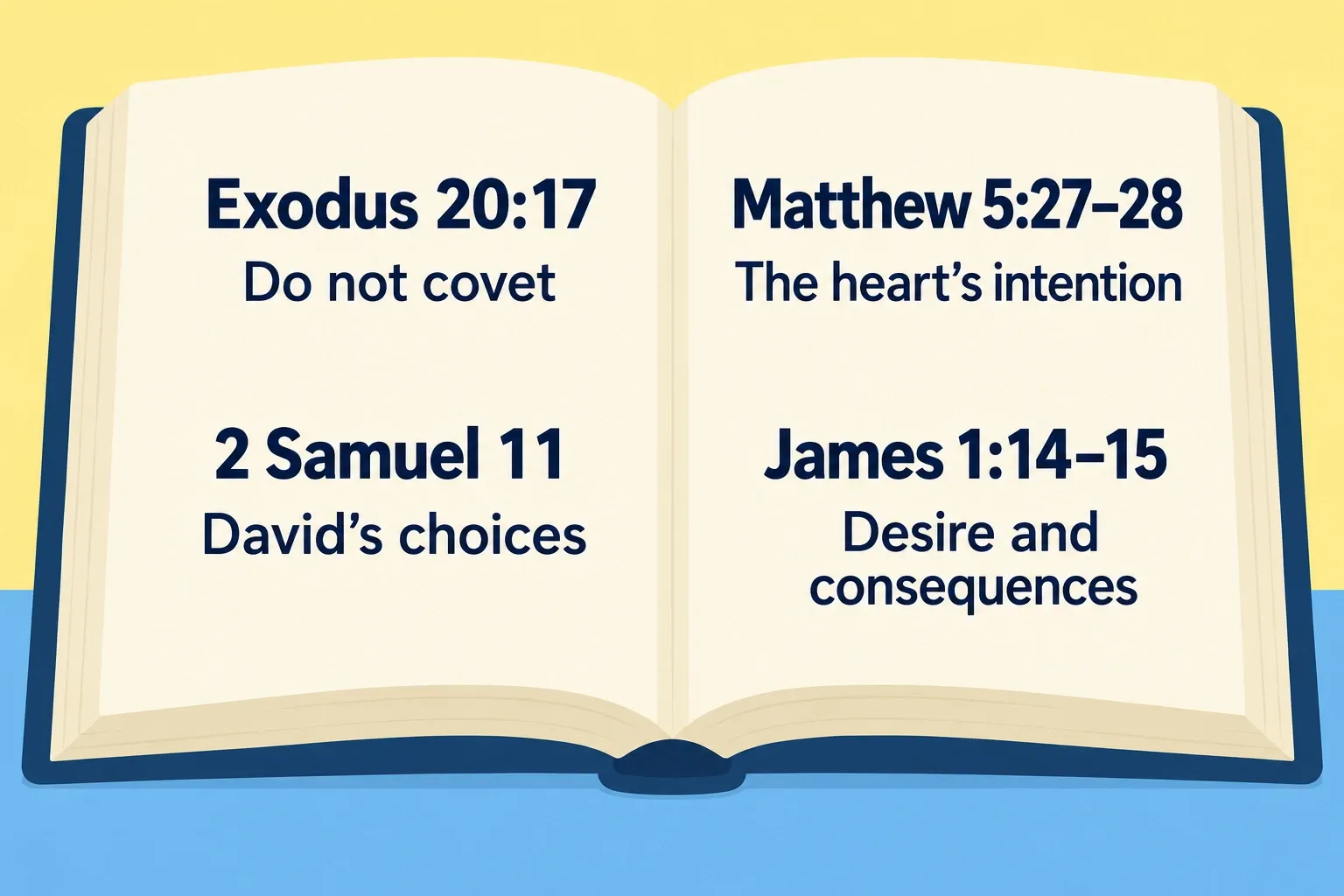
If you want to see what that looks like in real life, read 2 Samuel 11. It was the season “when kings go out” to war, “but David stayed at Jerusalem” (2 Samuel 11:1). One evening he got up from bed, walked on the roof, and “saw a woman bathing” (11:2). He asked who she was. He sent for her. By the end of the chapter he’s committed adultery and had her husband killed. The story doesn’t start with a plan to do evil. It starts with him staying home while his army was at war, and a look he didn’t turn away from.
If that sounds familiar, it’s because it works the same way every time, and James explains how.
Why it gets you every time (James 1:14–15)
— James 1:14-15But each one is tempted when he is drawn away by his own lust and enticed. Then the lust, when it has conceived, bears sin. The sin, when it is full grown, produces death.
Matthew 5 tells you where the line is. James tells you how guys end up on the other side of it.
“Drawn away” and “enticed” are hunting and fishing words (the second one is related to the Greek word for bait). That’s how lust works on you too. It puts the thing you want right in front of you, and you don’t really think about what it’s going to cost you until it’s over.
Then James switches to pregnancy language. Desire conceives, gives birth to sin, and the sin grows up. It’s a sequence, and if you’ve struggled with porn you’ll recognize every step:
- A random image or thought shows up. That’s temptation, and it’s not sin yet. Jesus was “in all points tempted like we are, yet without sin” (Hebrews 4:15).
- The second look, the quiet “ok fine”, the fantasy you let keep going. Lust has conceived.
- The search, the click, the act. Sin is born.
- Same time, same room, same device, for months. Sin is full grown.
One verse earlier James says God tempts no one (James 1:13), and here he says each person is drawn away “by his own lust”. That’s uncomfortable, because you can’t blame all of it on the algorithm or how you grew up. But it’s also good news, because your heart is exactly what God promises to change (Ezekiel 36:26).
The practical point is timing. The earlier you break the chain, the easier it is. By the time you’re at the search bar, it’s already mostly over.
That’s the theory. Here’s how it applies to the stuff people are really asking about.
So is it lust or not?
- Porn. Yes, by Jesus’ own definition. It’s looking for the purpose of wanting, and it’s built to keep you looking. John calls this “the lust of the eyes” (1 John 2:16), and says the world “is passing away with its lusts”. Porn is made for the eyes, it never runs out, and it always promises more than it delivers. The people on the screen are real people made in God’s image, being used.
- Fantasy, with no screen. Yes. Jesus puts the adultery “in his heart”. A lot of guys who quit porn find their head starts replaying old scenes or inventing new ones. That’s the same thing in a different room, and it needs the same honesty.
- Noticing someone. No. The first look just happens. What you do next is the question. Look away, put your attention somewhere else, and move on without running a whole trial in your head.
- Masturbation. The Bible never names it, but in practice it almost always runs on lustful fantasy, which is why we believe it’s sin and part of the same fight. Is it OK for Christians to masturbate? goes through that one properly.
- Thoughts you didn’t ask for. No. A thought you didn’t invite and don’t feed is temptation at most. If you catch yourself anxiously checking every thought for sin, talk to a pastor or counselor, because constant self-surveillance is its own trap.
One more thing from John, because it explains a lot of bad nights. He lists three directions lust runs in: “the lust of the flesh, the lust of the eyes, and the pride of life” (1 John 2:16). So lust in the Bible is bigger than sex. Greed, envy and chasing status come from the same place, and sexual lust rarely shows up alone. A lot of guys notice their worst nights are also the nights they feel overlooked or behind.
That covers what lust is. The Bible also says a fair amount about what to do about it, and most of it is practical.
What the Bible says to do about it
Decide before the moment (Job 31:1)
— Job 31:1I made a covenant with my eyes; how then should I look lustfully at a young woman?
Job isn’t describing some heroic save in the moment. He’s describing a decision he made in advance. A covenant is settled before the urge shows up, and honestly your strongest point of self-control is before temptation starts, not in the middle of it.
A covenant with your eyes can be super concrete: unfollowing the accounts that always lead somewhere, not scrolling in bed, deleting the app that starts the spiral, saying no to the “almost clean” content that warms things up.
Stop leaving supplies out (Romans 13:14)
— Romans 13:14But put on the Lord Jesus Christ, and make no provision for the flesh, for its lusts.
“Make no provision” means you stop leaving supplies out for the thing you say you hate. If Instagram always turns into fantasy, that’s provision. If the phone sleeps next to you, that’s provision. If nobody knows when you fall, the secrecy is provision too.
Leave (1 Corinthians 6:18)
— 1 Corinthians 6:18-20Flee sexual immorality! “Every sin that a man does is outside the body,” but he who commits sexual immorality sins against his own body. Or don’t you know that your body is a temple of the Holy Spirit who is in you, whom you have from God? You are not your own, for you were bought with a price. Therefore glorify God in your body and in your spirit, which are God’s.
Paul doesn’t tell you to stand there and prove how committed you are. He tells you to run. Joseph did exactly that when Potiphar’s wife grabbed him: “He left his garment in her hand, and ran outside” (Genesis 39:12).
A lot of guys treat lust like a test of toughness. They stay in the situation, argue with the urge, and call that courage. Scripture never calls it that. Some fights you win by leaving: close the laptop, walk out of the room, put the phone somewhere else, text the person who knows.
Run toward something (2 Timothy 2:22)
— 2 Timothy 2:22Flee from youthful lusts; but pursue righteousness, faith, love, and peace with those who call on the Lord out of a pure heart.
Fleeing is half the verse. The other half is pursuing, and it happens “with those who call on the Lord”, so with other people. If your whole plan is built around not doing one thing, your attention stays locked on that thing. Friends, sleep, honest work, the gym, church, serving somewhere. Those push lust out way better than just refusing it.
This is literally God’s will for you (1 Thessalonians 4:3–5)
— 1 Thessalonians 4:3-5For this is the will of God: your sanctification, that you abstain from sexual immorality, that each one of you know how to control his own body in sanctification and honor, not in the passion of lust, even as the Gentiles who don’t know God.
People say they want to know God’s will for their life. For this part of it, Paul just tells you. And notice the phrase “know how to control”. Self-control here is something you learn, which means you shouldn’t expect to have all of it at once.
Why grace has to come with all this
If you struggle with lust, these passages should hit hard. Scripture isn’t casual about using people.
But there’s a difference between conviction and despair. Conviction says: this is sin, bring it into the light, change course. Despair says: you’re disgusting and too far gone. The first one is from God. The second one hides behind true verses and pushes you away from repentance, and then the verses become part of the relapse cycle.
— Titus 2:11-12For the grace of God has appeared, bringing salvation to all men, instructing us to the intent that, denying ungodliness and worldly lusts, we would live soberly, righteously, and godly in this present age.
Paul says grace is the thing that teaches you to say no to worldly lusts. So it’s not that you have to beat lust first and then God gives you grace as a reward. He’s gracious to you first, and that grace is what trains you to say no.
When you fall, “if we confess our sins, he is faithful and righteous to forgive us the sins and to cleanse us from all unrighteousness” (1 John 1:9). And because Jesus was tempted in every way without sinning, you’re not confessing to someone who doesn’t get the pull. If shame is what keeps you down after a fall, Bible verses about shame and guilt is about exactly that.
Where to start this week
Knowing what lust is won’t stop it on its own. Here’s how to put these verses to work:
- Tell one person. “Confess your sins to one another” (James 5:16). Pick someone you trust and say plainly what you’re fighting. This whole thing runs on nobody knowing.
- Remove one provision. Name the app, account, device or room that usually starts things, and change it before the week is out.
- Decide your exit in advance. Choose where you’ll go and what you’ll do the next time the pull starts, so you aren’t deciding in the moment. Bible verses for sexual temptation is written for that moment.
- Learn three verses, each with a different job. One that tells the truth about lust (Matthew 5:28), one that commits you in advance (Job 31:1 or Romans 13:14), and one that gets you out the door (1 Corinthians 6:18 or 2 Timothy 2:22). Read them in the morning, not only after you fail.
- Build the other half. Pick one thing to pursue: a fixed bedtime, a weekly meal with friends, a church small group, a training plan. If you want a structured path with other believers, faith-based recovery programs compares the main options.