Intimacy Without Sex for Christian Couples in Recovery
Build intimacy without sex during porn recovery with practical steps for communication, consensual touch, trust, and spiritual connection.


Obex
Obex Team
You quit porn because you wanted freedom. You expected relief, maybe even closeness. Instead, home feels tense.
You sit next to your wife on the couch and think too much about where to put your hand. A hug feels loaded. Holding hands feels risky. If you avoid touch, she may feel rejected. If you initiate touch, you may fear arousal, pressure, shame, or relapse.
That confusion can happen in recovery. It doesn’t mean your love is fake. It means touch, trust, arousal, and safety may have become difficult to separate, and now you’re trying to build something honest in their place. For many Christian couples, intimacy without sex isn’t a consolation prize. It can be a way to rebuild trust, safety, and real connection without pressure.
Table of Contents
- Why Intimacy Feels Impossible After Quitting Porn
- Redefining Intimacy Beyond the Bedroom
- Mastering Vulnerable Communication
- The Art of Safe Physical Touch
- Connecting Through Shared Purpose and Faith
- Your Plan for Long-Term Connection and Relapse Prevention
Why Intimacy Feels Impossible After Quitting Porn
A lot of couples hit a strange wall after porn stops. Sex is off the table for a season, or at least it feels uncertain. The husband wants to stay clean. The wife wants safety, honesty, and peace. Both people care, but neither knows how to act normal anymore.
That’s where simple affection starts to feel dangerous. A hand on the shoulder can feel like a test. A cuddle can feel like a setup for failure. Silence grows because nobody wants to say the awkward thing out loud.

Why recovery changes the meaning of touch
Recovery can make non-sexual touch feel loaded. One spouse may fear that affection will automatically become a request for sex. The other may worry that arousal, pressure, or shame will return. There is no required “desensitizing” protocol and no universal timeline. The useful starting point is consent: agree on what kinds of touch feel safe today, what is off-limits, and how either person can pause without punishment.
This is why generic sexless marriage advice often falls flat. It usually assumes you just need more romance, better date nights, or new ways to connect. Those things can help. But they do not automatically repair broken trust or change the meaning touch has taken on in the relationship.
If that’s where you are, don’t treat this like a character flaw. Treat it like retraining.
Practical rule: In recovery, the first goal of touch is not pleasure. It’s safety.
What actually helps
You need structure. Vague promises like “we should connect more” won’t hold when shame spikes. Pick one small, repeatable practice instead: a ten-minute walk, an evening check-in, prayer before bed, or a hug that both people have already agreed does not need to lead anywhere.
It also helps to understand that porn recovery affects more than urges. It changes attention, tolerance for closeness, and the way you read your own body. If that part of your journey feels confusing, this guide on porn addiction recovery can give useful context for what rebuilding often looks like.
A better frame is this. You are not looking for “safe alternatives” to sex. You are learning a new relationship language. One where honesty matters more than performance, and small moments count more than intensity.
That language can be learned. Slowly. On purpose. Together.
Redefining Intimacy Beyond the Bedroom
If you only define intimacy as sexual chemistry, recovery will feel like a drought. If you define intimacy as closeness, trust, presence, and shared life, the picture changes fast.
Imagine building a house. Sex is not the foundation. It’s one room. If the foundation cracks, you don’t decorate the bedroom. You repair the structure underneath it.
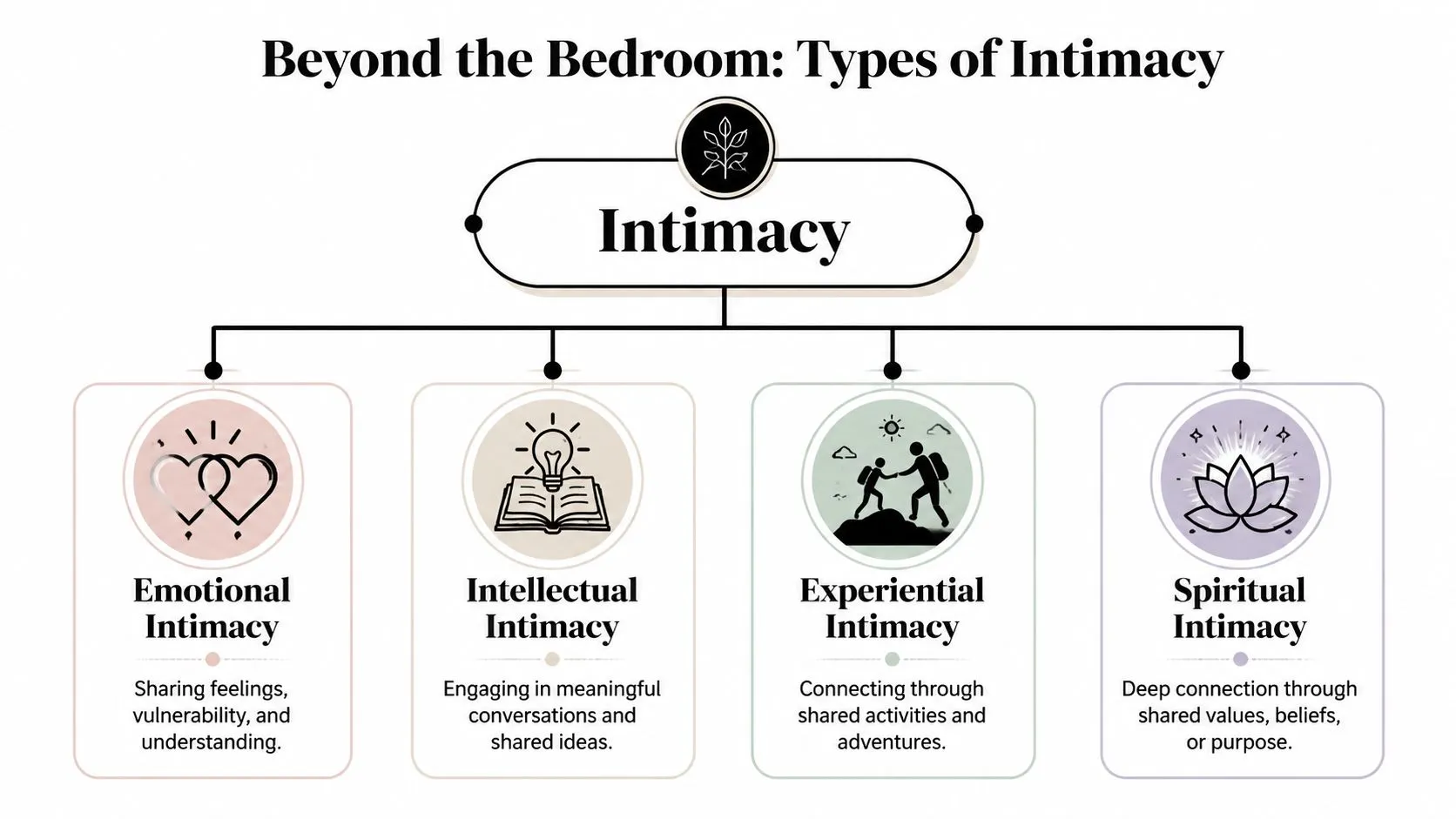
Four forms of closeness that matter
Here are four kinds of intimacy without sex that give a recovering relationship real strength.
- Emotional intimacy means telling the truth about what’s going on inside. Fear. Grief. Temptation. Hope. Disappointment. You stop editing yourself just to keep the peace.
- Intellectual intimacy means sharing ideas, questions, plans, and convictions. Not just logistics. Not just bills and calendars.
- Experiential intimacy grows when you do life side by side. Cooking dinner. Walking after church. Cleaning the garage together. Taking a drive without screens.
- Spiritual intimacy grows when you bring God into the room together. Prayer. Scripture. Confession. Gratitude. Worship.
Many couples overlook experiential intimacy because it seems too simple. But shared activities such as cooking, walking, or working on something together create room for attention without sexual pressure. Those ordinary moments count.
What this looks like in real life
You do not need a dramatic reset. You need a broader menu.
A lot of husbands in recovery get stuck because they assume every meaningful connection must involve touch. It doesn’t. Some of the safest rebuilding work starts with attention and presence.
A couple can feel deeply connected at the end of a walk, after praying for five minutes, or while talking honestly in the kitchen. That counts.
Try this short reset list:
| Type of intimacy | One practical example |
|---|---|
| Emotional | Share one fear from the day without trying to fix it |
| Intellectual | Talk about one book, sermon, podcast, or idea |
| Experiential | Cook one meal together from start to finish |
| Spiritual | Pray one sentence each before bed |
For husbands who want a clearer picture of sacrificial, attentive love in marriage, this reflection on how to worship your wife can be a useful companion. Not because your wife is an idol, but because many men need to relearn honor, tenderness, and daily care.
When you expand the definition of intimacy, pressure drops. That’s often the first real relief a couple feels.
Mastering Vulnerable Communication
Before touch feels safe, words need to feel safe. Many couples try to fix physical distance while their conversations still feel defensive, vague, or sharp. That rarely works.
Talking is often the first form of safe touch. Not fancy talking. Honest talking.
Use simple language that lowers defensiveness
Start with sentences that describe your experience instead of accusing your spouse.
“I feel anxious when we cuddle because I’m afraid my body will go into old patterns.”
“I feel sad when we avoid affection because I miss you.”
“I want to be close to you, but I need us to move slower.”
Those sentences do two things. They remove blame, and they make room for response.
Compare the difference:
| Instead of asking… | Try asking… |
|---|---|
| Why are you so distant? | When do you feel most disconnected from me? |
| Why can’t we just be normal? | What part of closeness feels hardest right now? |
| Are you ever going to trust me again? | What helps you feel safer with me? |
| Do you still want me? | What kind of connection feels good to you these days? |
| Why do we always fail at this? | What has gone better than we expected lately? |
Ask questions that create curiosity
Recovery can turn every conversation into a problem-solving session. That burns people out. You also need questions that reopen wonder.
Try a few of these:
- For emotional openness Ask, “What felt heavy today?”
- For repair Ask, “Did anything I did this week make you feel alone?”
- For reassurance Ask, “What helps you feel pursued without pressure?”
- For hope Ask, “What would closeness look like this month if it felt peaceful?”
- For faith Ask, “What do you think God is teaching us in this season?”
These aren’t scripts for one big night. They work best in small, repeatable conversations.
Speak in doses your spouse can receive. A hard truth said gently usually lands better than a perfect speech said late and loud.
Use boundaries that sound clear, not cold
A lot of couples either avoid boundaries or weaponize them. Neither helps. Boundaries should make connection safer, not harsher.
Here are examples:
- Around touch “Can we sit close tonight, but skip cuddling if either of us feels tense?”
- Around timing “I don’t want to talk about relapse right before bed. Can we talk after dinner instead?”
- Around triggers “If I seem shut down, please ask if I’m overwhelmed before assuming I’m rejecting you.”
- Around repair “If a conversation gets heated, let’s pause and come back in twenty minutes.”
If your relationship has also been shaped by manipulation, denial, or spiritual pressure, do not use a couples exercise to talk yourself out of what happened. Some couples need qualified outside help and clear safety boundaries before they can rebuild trust in the present.
Keep the rhythm small and steady
What works is boring on paper. Daily check-ins. Calm tone. Short honesty. Consistent follow-through.
What doesn’t work is trying to solve months of pain in one emotional conversation. That usually leads to flooding, shutdown, and regret.
Try a simple nightly pattern:
- Share one feeling.
- Name one gratitude.
- Mention one need for tomorrow.
- End with one sentence of prayer, if that fits your marriage.
That kind of rhythm rebuilds closeness because it teaches both of you the same lesson. Home is a place where truth can be spoken and survived.
The Art of Safe Physical Touch
Touch after porn recovery needs a new meaning. For a while, your brain may still assume touch has only two outcomes. Escalation or avoidance. Neither creates peace.
You need a middle path. Slow, consent-based, and specific.
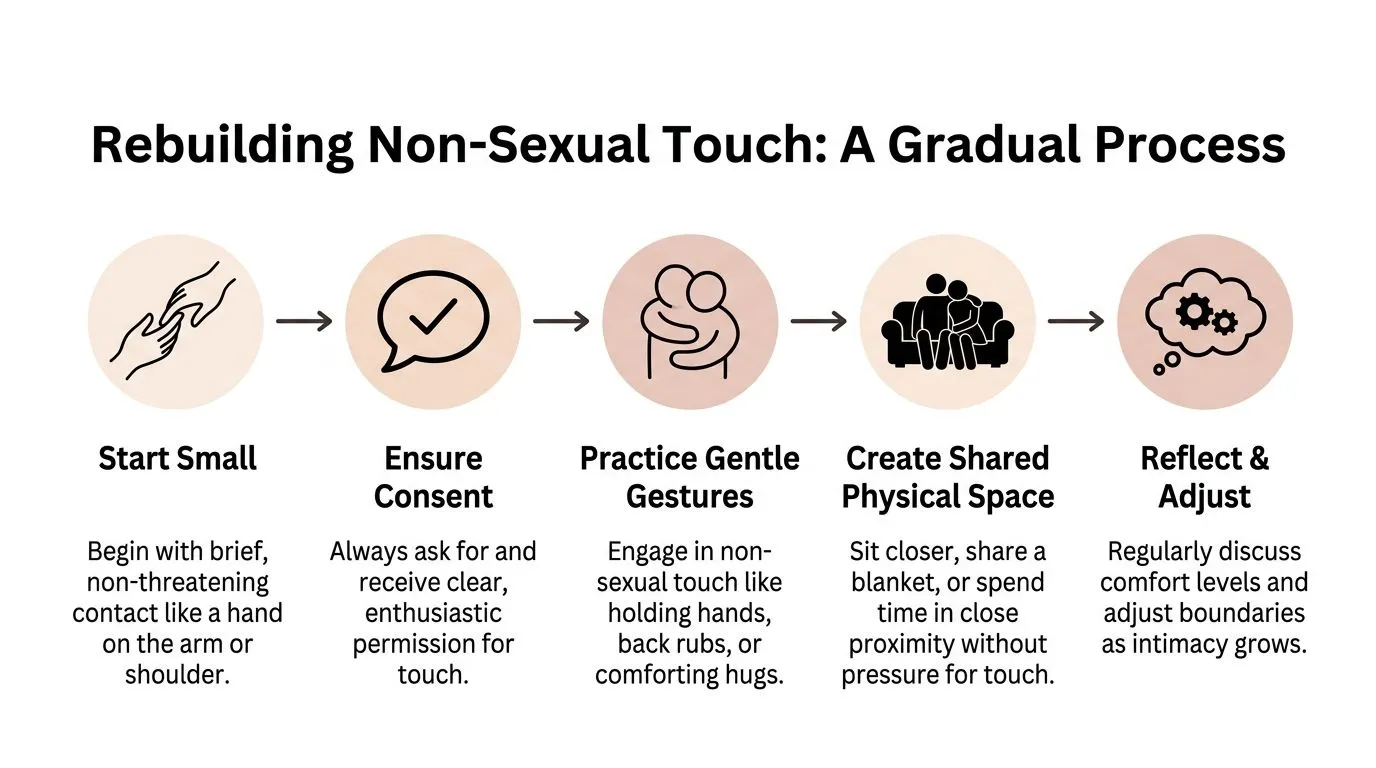
Start with the least loaded forms of contact
Don’t begin with cuddling in bed if that setting already carries pressure. Start with touch that feels almost ordinary.
A hand on the shoulder in the kitchen. Sitting side by side on the couch. Brief eye contact with knees touching. A light touch on the forearm while talking.
The point is not to prove self-control. The point is to teach your body that closeness can exist without demand.
Simple affection can support connection when both partners want it. The important part is not forcing a biological result from a hug. It is showing care in a way that feels safe, welcome, and free from an unspoken demand for more.
Use a touch ladder
A touch ladder gives you order. It removes guessing.
Try a sequence like this:
- Shared space Sit near each other for a few minutes with no touching required.
- Brief contact Touch an arm, shoulder, or upper back for a few seconds.
- Hand contact Hold hands during prayer, a walk, or a car ride.
- Short embrace Try a brief hug, then stop before either person feels trapped.
- Longer calm touch Sit with a hand on the back or shoulder while talking.
Stay on one step as long as needed. You do not earn points for moving faster.
Here’s a helpful visual example to keep in mind as you practice:
Ask before, check in after
Many couples get embarrassed. They think permission will kill spontaneity. In early recovery, permission creates safety. Safety is what makes genuine warmth possible later.
Use plain questions:
- Before touch “Would it feel okay if I held your hand for a minute?”
- During touch “Still okay?”
- After touch “How did that feel for you?”
These questions are not robotic. They are respectful. They also lower the fear that one person is secretly expecting more.
Know what usually does not work
Some patterns look loving but backfire fast.
- Ambiguous cuddling If neither person knows the purpose or boundary, anxiety rises.
- Testing yourself Touch is not a relapse challenge. Don’t use your spouse to measure recovery progress.
- Silent endurance If touch feels activating or shame-filled, say so. Quiet discomfort teaches the wrong lesson.
- Jumping to high-trigger settings Bedtime, darkness, and long embraces may be too much at first.
A better question is not “Can we handle more?” It’s “Did that leave us feeling safer?”
Keep physical touch boring enough to heal
Early recovery touch should feel almost plain. That’s healthy.
You are building a memory bank of contact that does not end in fantasy, pressure, or secrecy. Over time, many couples notice that simple affection becomes easier. Less loaded. Less performative. More human.
That’s the win.
Connecting Through Shared Purpose and Faith
A marriage gets stronger when the couple remembers they are more than two people managing temptation. They are a team.
When couples focus only on avoiding failure, the relationship can become thin and anxious. Shared purpose gives the marriage weight. It turns your attention outward and upward.

Faith can anchor intimacy without sex
For Christian couples, spiritual habits are not just nice extras. They can stabilize a season that feels emotionally messy.
You do not need a polished devotional routine. Start small enough that you’ll do it.
- Pray one sentence each before sleep or before leaving for work.
- Read a short Psalm together and ask, “What stands out to you?”
- Attend church with intention and talk afterward about one thing that convicted or encouraged you.
- Serve together in one simple way. Meals, setup, children’s ministry, hospitality, or care for a neighbor.
These practices matter because they move the marriage away from a constant spotlight on sex. They remind both of you that your union has meaning, duty, and grace beyond chemistry.
Shared projects build teamwork
If faith practices feel difficult at first, begin with a mission you can see and finish.
Plan a small garden. Repaint a room. Train for a local event. Cook through a recipe book. Volunteer somewhere once a month. Build a budget together. Take a weekly walk with no phones and one question to discuss.
What matters is not the activity itself. What matters is the repeated experience of doing something side by side.
Couples often reconnect when they stop staring at the relationship and start building a life together again.
Shared purpose also helps the spouse in recovery move away from private coping. Porn trains isolation. Purpose trains partnership.
What makes this different from distraction
Some couples stay busy to avoid pain. That isn’t what we want. Shared purpose only helps when it includes honesty.
If you serve at church but never talk about fear, the mission becomes a mask. If you plan trips but keep hiding urges, the project becomes a detour.
Use a simple filter. After a shared activity, ask:
- Did we feel more like teammates?
- Did either of us feel unseen?
- Did this create peace, or just keep us occupied?
- Did we invite God into it, or only our own effort?
A healthy shared purpose does not replace emotional work. It supports it. It gives your marriage a place to stand while trust slowly heals.
Your Plan for Long-Term Connection and Relapse Prevention
Recovery gets shaky when couples depend on emotion alone. Some weeks you’ll feel close. Some weeks you won’t. That’s why long-term connection needs a plan.
A good plan is simple enough to repeat and clear enough to use when stress rises.
Build a relapse-aware intimacy rhythm
Use five parts.
- Daily connection Pick one small habit. A check-in, prayer, walk, or evening hug.
- Weekly review Ask what felt connecting and what felt hard.
- Touch boundaries Agree on what kinds of affection feel safe right now.
- Trigger response Decide what happens if one of you feels flooded, tempted, numb, or ashamed.
- Repair plan Name how you come back after conflict or emotional distance.
Porn offered counterfeit intimacy on demand. Real intimacy without sex grows through repetition, honesty, and restraint.
Hims’ overview of sexless relationships makes an important point. Relationships can survive and even thrive when emotional closeness and shared goals remain strong. Sexual satisfaction and emotional intimacy often rise together, but some couples still find fulfillment through other forms of connection.
Watch the attachment pattern under the conflict
Sometimes the actual issue is not touch. It’s panic.
One spouse reaches for reassurance. The other withdraws because pressure feels overwhelming. Then both people feel abandoned. If that sounds familiar, name the cycle without diagnosing each other or blaming each other’s character. A qualified couples therapist can help when the pattern keeps repeating or when touch does not feel emotionally safe.
If your recovery plan still depends on white-knuckling, it will eventually strain the relationship. Sustainable change usually needs structure, honesty, and accountability. This article on why accountability works better than white-knuckling explains why that matters.
Keep the goal clear
The goal is not to become a perfect couple. The goal is to create a marriage where secrecy has less room to grow.
That happens when your relationship includes words, touch, faith, and shared purpose in forms that both people can tolerate. It also happens when setbacks lead to conversation instead of hiding.
If intimacy without sex feels slow, that doesn’t mean it’s failing. It often means you’re building it honestly for the first time.
If porn has damaged trust, read how to talk when your husband watches porn and build the follow-through described in why accountability works.
If you want support while rebuilding intimacy and staying consistent in recovery, Obex can help. It gives you practical tools for porn recovery, accountability, streak tracking, and high-urge moments, so you can build discipline without trying to carry the whole process alone.