When Your Husband Is Addicted to Porn: A Recovery Roadmap
Practical steps for addressing a husband’s compulsive porn use, setting boundaries, finding qualified support, and rebuilding trust.


Obex
Obex Team
He’s on his phone after midnight again. She’s pretending to sleep, but she feels the same old knot in her stomach because the pattern is getting harder to ignore. That’s where a lot of marriages sit right now, not in a dramatic collapse, but in a quiet loop of secrecy, shame, irritation, and hope that tomorrow will be different.
This recovery roadmap takes a direct view of that loop. Porn use in committed relationships is not just a private habit when it involves repeated loss of control, secrecy, or relationship harm. In marriage, the damage often shows up as distrust, conflict, and emotional distance, and that is where recovery has to start.
Table of Contents
- What Husbands Porn Addiction Really Looks Like in 2026
- Is It Addiction or Just a Habit
- First 72 Hours When You Decide to Stop
- How to Tell Your Spouse Without Making It Worse
- Building Your 30-Day Recovery System
- When Relapse Happens and What to Do Next
- Rebuilding Trust, Faith, and the Long Game
What Husbands Porn Addiction Really Looks Like in 2026
A husband can look fully functional and still be stuck. He goes to work, pays bills, coaches a team, laughs at dinner, then slips into the bathroom with his phone or stays up after everyone’s asleep. That hidden rhythm is why so many wives feel crazy, because the outside life still looks normal while the private behavior keeps pulling the marriage off balance.
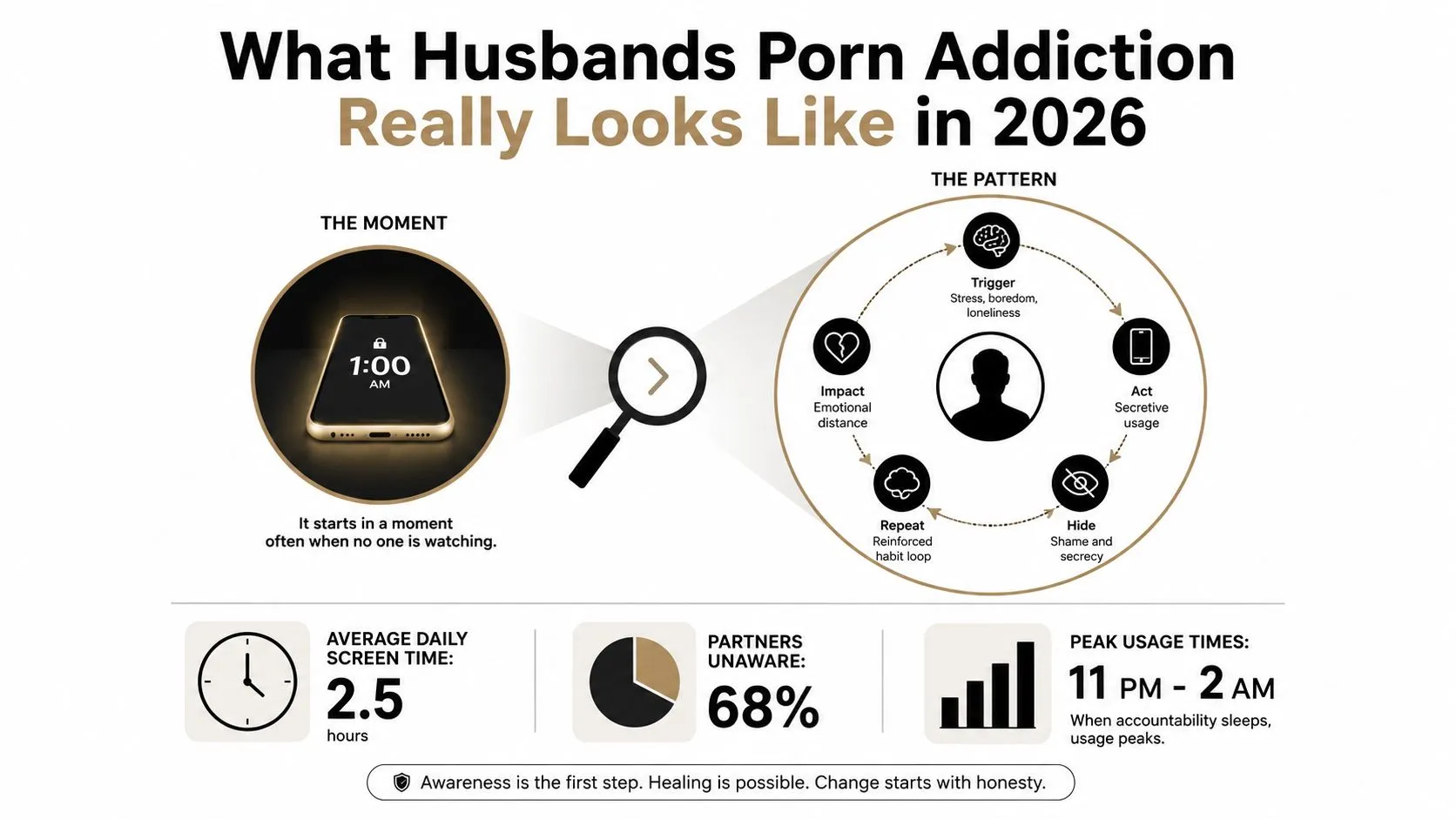
The useful way to think about husbands porn addiction is as a pattern. Trigger, urge, secrecy, relief, repeat. It’s a behavior loop, not a personality label, and that matters because you can change a loop much faster than you can argue with shame.
What the pattern usually includes
You’ll usually see three things together, even if nobody says them out loud. First, the use gets more hidden. Second, the husband starts protecting the habit from interruption. Third, the relationship absorbs the fallout in the form of distance, distrust, or a flat feeling that something is off.
Do not force a substance-addiction label onto the situation. Focus on observable behavior: repeated failed attempts to stop, secrecy, loss of control, and meaningful consequences. A licensed clinician can assess whether the pattern fits compulsive sexual behaviour disorder or another condition.
Practical rule: if the behavior keeps moving deeper into secrecy, and the person keeps arranging life around it, treat it as a recovery problem, not a “bad habit” problem.
For spouses, this is the part that matters most. Many men don’t quit because they feel bad. They quit when the pattern stops being invisible and starts being measurable. That’s why the rest of this roadmap is built around facts, honesty, blockers, accountability, and short feedback loops.
If you’re a husband, focus on the first 72 hours. If you’re the wife, focus on what you can verify instead of what you can’t. If you’re not sure whether this is addiction or something smaller, jump to the next section and use the signals, not the fear.
Is It Addiction or Just a Habit
Porn use does not all land in the same place. One man may have a strong sex drive and use porn occasionally. Another may use it as a pressure release when he is stressed. A third may feel upset mainly because the behavior clashes with his values, even if it has not taken over his life. The right response depends on which pattern is in front of you.
Five signals that matter more than frequency alone
Escalation is a real warning sign. A man who used to click casually but now seeks more intense content, more novelty, or longer sessions is showing a pattern shift. The content has started to carry the load that self-control used to handle.
Hiding matters just as much. If he clears history, changes devices, stays up later, or becomes oddly defensive when asked simple questions, the issue is no longer just use. It’s concealment.
Failed attempts to quit are another marker. A sincere “I’m done” followed by the same cycle a few days later usually means the habit has more grip than willpower can manage alone.
Continued use despite consequences is the line people keep trying to skip over. If it’s hurting intimacy, creating conflict, disrupting sleep, or making him feel split in half, but he keeps going, that’s not casual use anymore.
Porn as the main coping tool is a major sign. If he reaches for porn first when he’s bored, lonely, angry, anxious, or rejected, the habit has become regulation, not entertainment.
He’s not just choosing porn. He’s using it to manage a feeling he doesn’t know how to sit with.
Moral incongruence and compulsive use are not the same thing
A man can feel ashamed of porn use without being compulsive. That’s moral incongruence, and it can create real distress even when the behavior isn’t daily or escalating. A different man may not feel much shame at all, but still be stuck in a rigid compulsive loop that keeps coming back.
That distinction matters because the first case needs honesty, boundaries, and sometimes values work. The second case usually needs structure, accountability, and a real recovery plan. If you blur those together, you either overreact or underreact.
A 2023 paper noted that a significant portion of porn-addiction research has focused on heterosexual male addicts while relatively little is known about women partners, which is one reason many couples feel under-served when they try to sort out what’s really going on (Springer). The field is still uneven, so use behavior, consequences, and honesty as your compass.
First 72 Hours When You Decide to Stop
The first three days are about cutting access, telling one safe person, and getting your triggers out of your head and onto paper. Don’t make this a vow you keep in private. Private vows usually die in private.
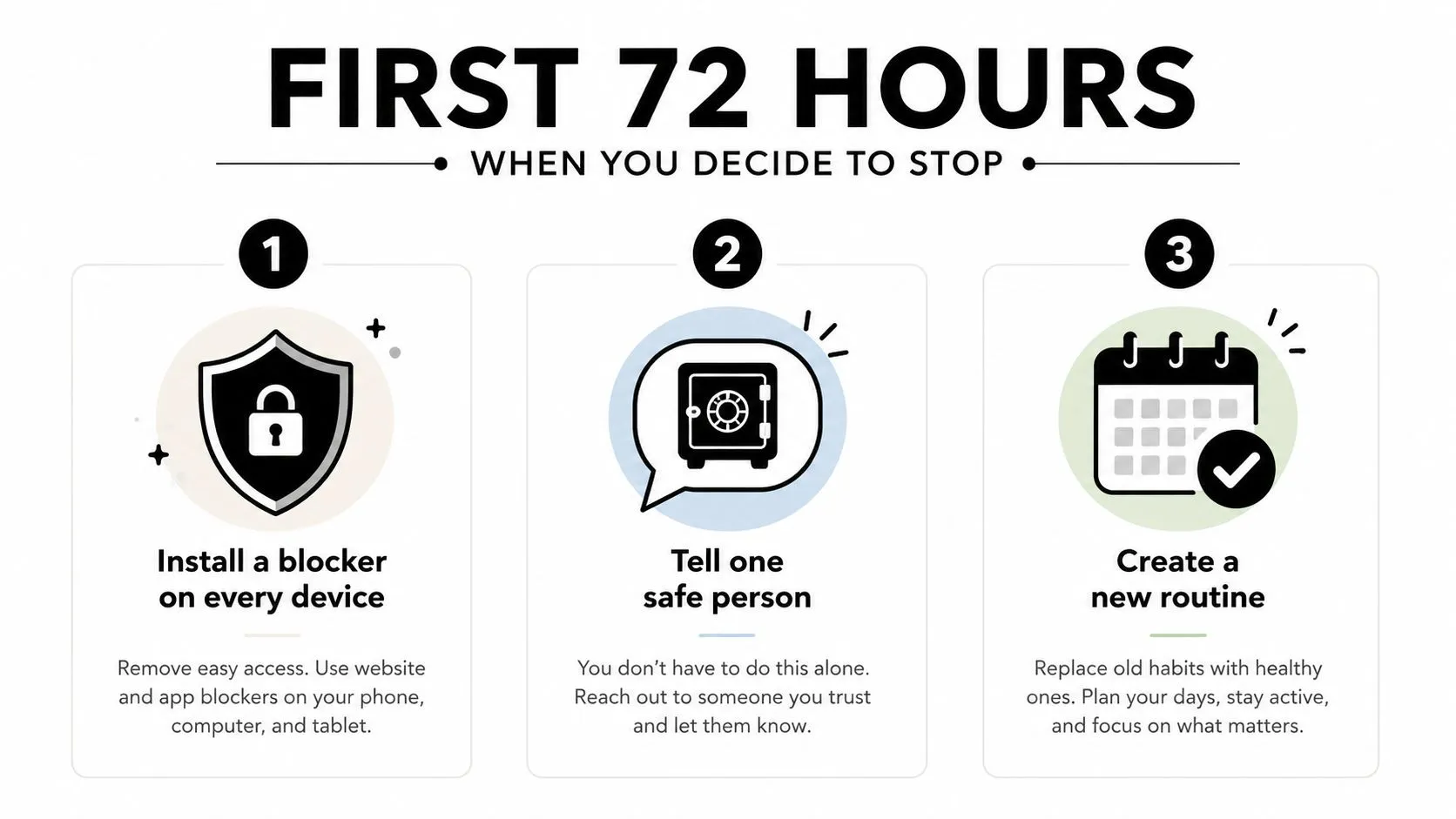
Step one is to block access on every device
Use a real blocker, not a browser promise. If you’re on Mac, Obex Desktop is one recovery-focused option, and it fits into a broader setup that can also include device-level filters, DNS-level filtering, and router-level controls. Pick the layer you’ll keep turned on.
Step two is to tell one safe person
Choose someone who can hold a secret, not someone who likes drama. He should be steady, non-mocking, and willing to ask direct questions later. A spouse can be part of that circle, but if you’re not ready for that conversation yet, tell one trusted friend, mentor, pastor, or counselor first.
Use this script if you need words: “I’ve been stuck in porn use, I’m taking it seriously, and I need one person to know so I can stop hiding. I’m not asking you to fix me. I’m asking you to check in with me this week.”
Step three is to map your triggers
Write two columns on paper. On the left, list the moments that usually open the door, like late nights, stress, boredom, conflict, or being alone after everyone goes to bed. On the right, put the replacement action you’ll do instead, like a walk, shower, journal entry, or text to your accountability person.
Use this simple rule for the first week. If it’s after your bedtime and you’re alone with a screen, your brain is lying to you. Sleep first, phone out of reach, and no aimless scrolling.
For a careful look at what some people report after changing a sexual habit, read what the evidence says about sex withdrawal effects.
Survival rule: don’t trust a tired brain, a lonely night, or a phone you’re handling without purpose.
How to Tell Your Spouse Without Making It Worse
The goal is clean truth, not damage control. If you are the husband, say it plainly and keep it short. If you are the wife who just found out, focus on the next move, not on whether the speech sounded perfect.
What the confession should sound like
Keep the confession direct. “I’ve been using porn, I hid it from you, and I understand this hurts trust. I’ve already started taking concrete steps, and I want us to talk about what safety and transparency should look like next.”
That is enough. Do not add a long speech about childhood, stress, loneliness, or how hard this has been for you. Those things may be true, but they belong later because they sound like explanation, not ownership.
Say the facts, then stop talking.
What she may do next
Some wives go straight to anger. That is a normal response after shock.
Some go quiet. That can look cold, but it is often self-protection while they process what they just heard.
Some become hypervigilant. They check devices, ask the same questions again, and watch your face for lies. That is not irrational. It is what happens when trust has been bent.
Give her room to react without trying to shape her reaction.
What not to say
Do not say, “I promise it won’t happen again.” You cannot promise that.
Do not hide behind mental health language to escape responsibility. Anxiety, depression, trauma, and stress can be part of the picture, and you are still responsible for the choice.
Do not ask for a neat timeline, like “Give me 30 days and I’ll fix it.” Recovery does not work on a deadline. It works on evidence.
If she wants a measuring stick, give her transparency instead of speeches. Shared screen time, voluntary accountability reports, and agreed check-ins are healthy. Surveillance without consent is not healthy, and vague reassurance with no proof is worse.
When the conversation has stalled, a licensed couples therapist with experience in compulsive sexual behavior and betrayal trauma can help both people create structure without turning the sessions into blame or surveillance.
Building Your 30-Day Recovery System
The first month should be boring in a good way. Same morning routine, same check-in, same accountability rhythm, same blocking, same movement. Recovery gets stronger when it becomes ordinary.
Four daily non-negotiables
Start the day with one sentence in a journal. Keep it simple. “Today I will not feed the habit.”
Verify your blocker is still on. Don’t assume.
Send one accountability message. It can be short, but it has to be real.
Move your body for at least ten minutes. Walk, lift, stretch, run, or do pushups. The point is to break the stuck state before it becomes a screen state.
Weekly anchors that keep the system honest
On Sunday, review what triggered you. Don’t just write “stress.” Name the hour, the setting, and the feeling.
Make one call to your accountability partner. Texts are useful, but a live voice catches what messages hide.
Do one uncomfortable conversation you’ve been avoiding. Recovery weakens when your life stays full of unresolved tension.
Tools and support options
Obex gives users streak tracking, panic-mode support, and a recovery loop that helps turn progress into momentum. Generic blockers can still help, but they usually stop at restriction, while a recovery tool adds tracking and accountability. Obex Desktop, by design, is for Mac users who want blocking and recovery support on the same machine.
| Tool Type | Best For | Limitation |
|---|---|---|
| Blocker only | Cutting access fast | Doesn’t change habits by itself |
| Accountability partner | Truth and follow-through | Depends on trust and consistency |
| Obex-style recovery app | Tracking, urges, streaks, and structure | Still needs a human support loop |
| Couples support | Shared recovery and trust repair | Can be hard to sustain without clear boundaries |
If you don’t have one trustworthy person, don’t wait for perfect conditions. Ask a pastor, mentor, small-group leader, therapist, or mature friend to step into a simple role: receive updates, ask direct questions, and remind you why you started.
The web-based couples work with 314 couples found 64.3% completion and only small average reductions in porn use, while daily users at baseline saw much larger reductions, which is a good reminder that outcomes depend heavily on starting point and follow-through (PMC). In other words, the people who need the most structure usually need it most consistently.
For hands-on support, verify a clinician’s license and ask directly about experience with compulsive sexual behavior, partner trauma, disclosure, and relationship repair.
When Relapse Happens and What to Do Next
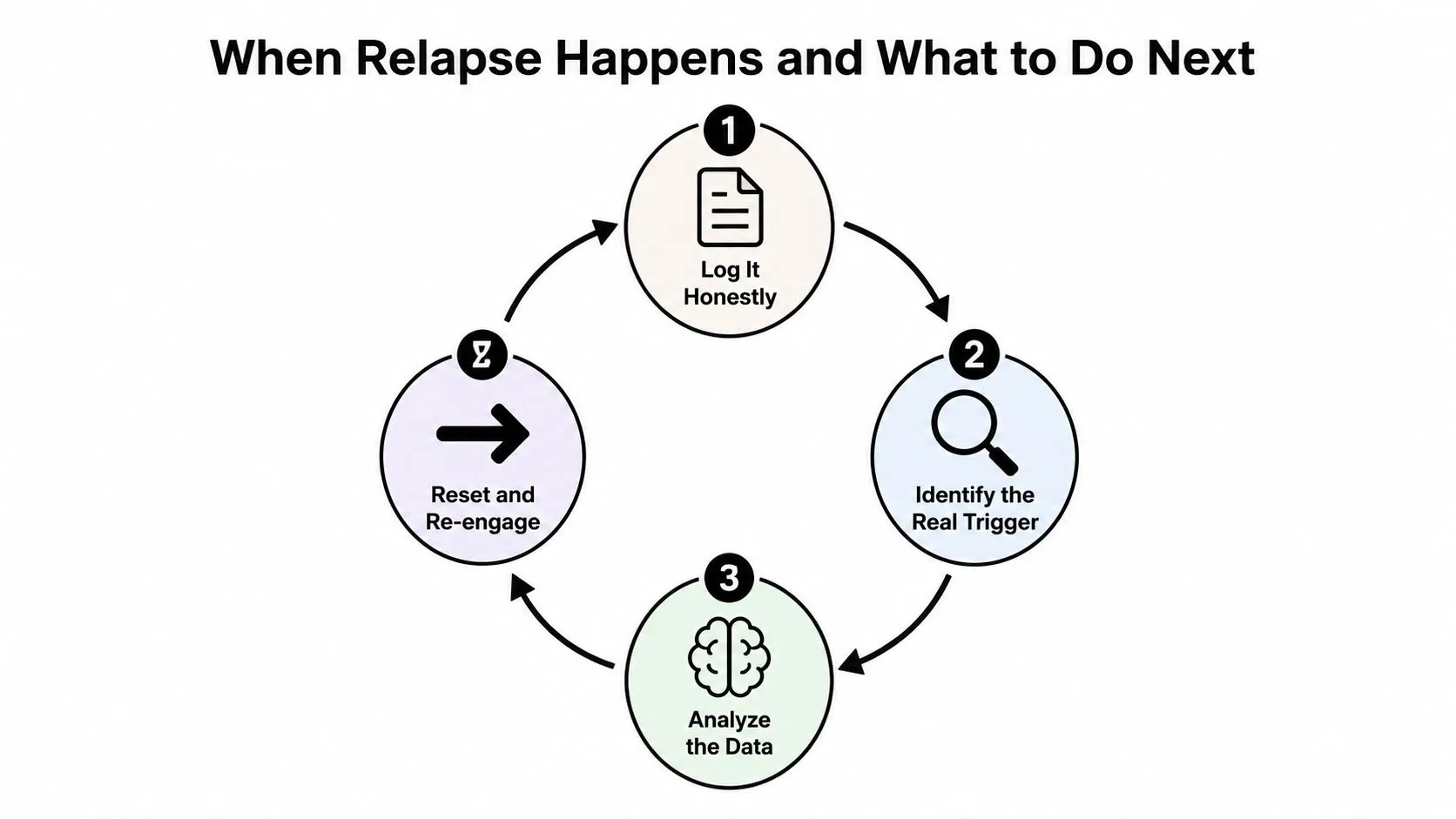
A slip is data. Treat it that way. If you make it a catastrophe, you’ll hide it. If you make it ordinary, you’ll learn from it.
The 24-hour response
Log the slip. No soft language. No “almost.” Write what happened, when it happened, and what came right before it.
Identify the trigger. “I was stressed” is too vague. Was it conflict, fatigue, boredom, a late-night phone session, or a fight that left you flooded?
Reach out to your accountability partner within 12 hours. The point is to cut secrecy before it hardens.
Four traps to interrupt quickly
The all-or-nothing spiral sounds like, “I already failed, so I might as well keep going.” That line is poison. Stop it early.
The secrecy rebound says, “No one needs to know.” That’s how relapse grows teeth.
The substitution trap swaps one compulsive behavior for another that feels safer but still keeps you stuck. That’s not recovery, just costume change.
The celebration relapse happens when a man rewards a good streak with “one last time.” That last time is rarely last.
The NoFap flatline can also show up around weeks 2 to 3. Motivation drops, emotions can feel muted, and the brain starts bargaining for old stimulation. That period isn’t proof that recovery is failing, it’s proof that your system is adjusting.
If you want a structured reset plan after a slip, relapse prevention strategies is a useful companion because it keeps the focus on shortening the gap between mistake and correction.
Rebuilding Trust, Faith, and the Long Game
Recovery becomes real when it starts changing the marriage, not just the streak count. A month of discipline matters. So does the next month. Trust returns through repeated proof, not emotional speeches or short bursts of remorse.

Three tracks to keep steady
On the personal track, keep the blocker, monthly reviews, and therapy if you need it. If you are still white-knuckling every week, the system is underbuilt. Add structure before you ask for confidence.
On the marriage track, use scheduled check-ins, shared goals, and couples therapy when the talks keep going in circles. The point is not to win the discussion; it is to make the relationship safe enough for honesty and informed boundaries to stick.
On the faith track, Christian men often do better when they stop treating this like a private purity issue and start treating it like community formation. Scripture, accountability, and fasting rhythms can all serve that work when they are used authentically, not performatively. Faith should steady the man and lower the secrecy, not become another way to hide.
For couples who want a clearer picture of how porn use affects the relationship itself, pornography and marriage gives useful context for the repair work.
When to bring in a professional
Bring in help if the use keeps going despite real effort, if anxiety or depression is part of the picture, if there is trauma history underneath the pattern, or if your spouse is emotionally overwhelmed. Waiting too long usually makes repair harder.
The American Sociological Association reported that beginning pornography use between survey waves nearly doubled the probability of divorce, from 6% to 11%, and nearly tripled it for women, from 6% to 16% (ASA). That does not mean every marriage ends this way. It does mean delay has a cost, and the cost is usually paid at home first.
What recovery often looks like over time
In year one, the big wins are honesty, less hiding, and a more stable daily pattern.
In year three, the habit of secrecy should be much weaker, and the marriage should feel safer because the truth does not have to be dragged out. The man is no longer guessing at his own triggers. He already knows them, and he acts early.
Beyond that, recovery looks less like constant crisis management and more like a man who uses support before he is cornered. His wife is not treated like a witness to a hidden life. She becomes a partner in a life that is finally lived in the open.
If you are ready to stop improvising and start using a recovery system, Obex gives you blockers, streak tracking, panic support, and accountability tools. Pick one concrete step today and review it with someone you trust.