How to Quit Porn Addiction: A Practical Christian Guide
Decided to quit porn again? How to stop watching porn for good: what to set up today on iPhone and Mac, a plan for urges, who to tell, and what to do after a relapse.

Obex
Obex Team
You’ve probably decided to quit porn before, maybe a bunch of times, maybe as recently as last night when you put the phone down feeling kind of gross and told yourself that was the last time.
That’s super normal, and it doesn’t mean you’re not serious about it. The decision usually holds for a while, and then it breaks on some ordinary evening a few weeks later, when you’re tired, you’re alone, the phone’s already in your hand, and what you decided back then doesn’t feel like it means much anymore. Whether you’d call it a porn addiction or just a habit you can’t shake, quitting for good is mostly about setting things up while your head is clear, so that evening goes differently when it comes.
This guide covers what to set up today (most of it takes under an hour), how to block porn on your phone and computer, how to handle triggers and urges, what to do after a relapse, and when it’s worth getting more help.
What to do today
Do these today while you’re motivated, because all of it is way easier to set up on a calm afternoon than to think about at 11pm.
- Turn on content restrictions on your phone. On iPhone, Screen Time does this for free in about five minutes (the steps are further down), and it’s best if someone else sets the passcode.
- Block it on your computer too. On a Mac, that’s Obex Desktop (also further down). For Windows or a Chromebook, there’s a separate guide to blocking porn on your computer.
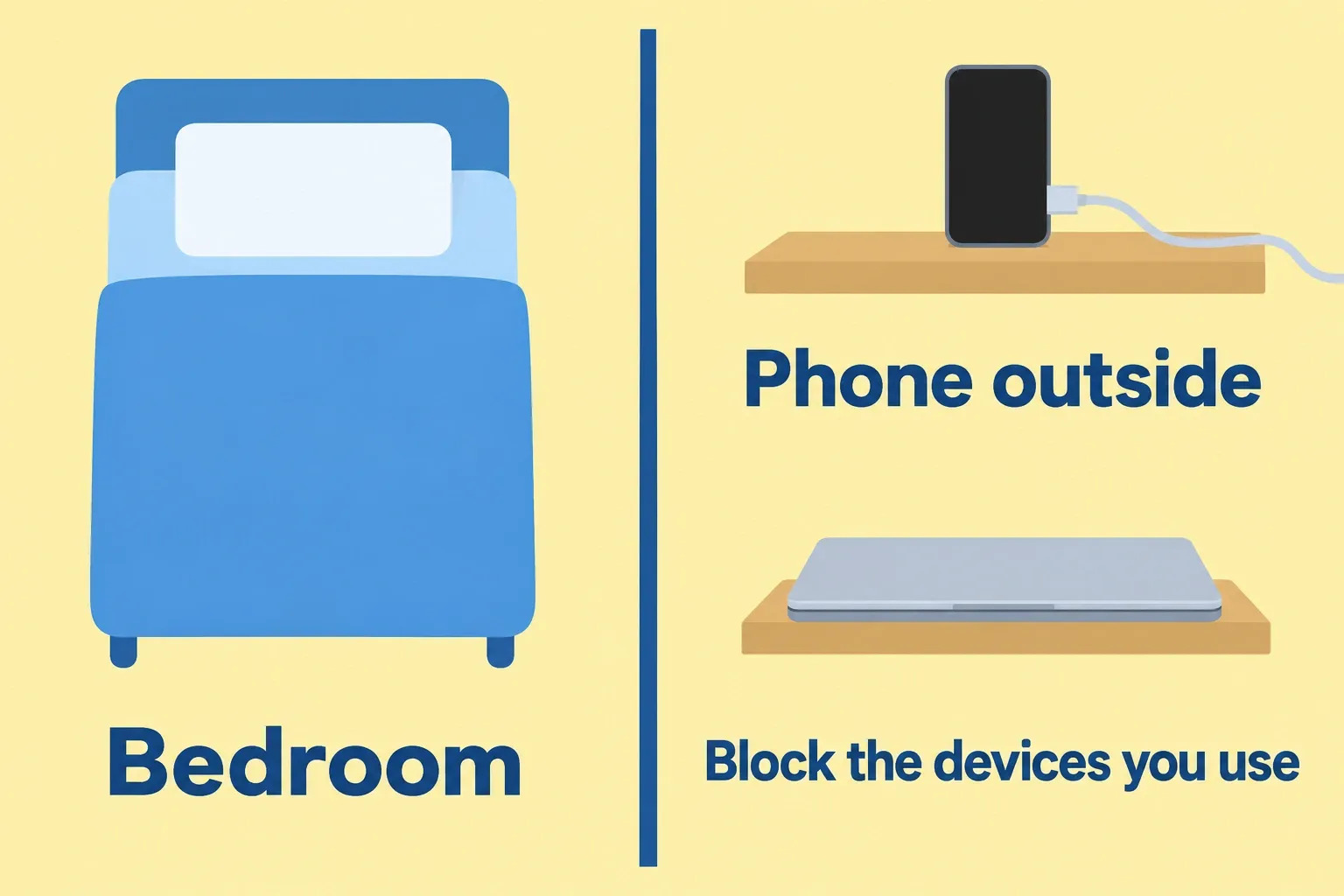
- Charge your phone outside the bedroom tonight. A cheap alarm clock means “I need it for my alarm” stops working as an excuse.
- Delete the on-ramps. Bookmarks, saved logins, the hidden folder, the app where you usually end up finding it. Don’t keep anything “just in case.”
- Tell one person. You can send something like: “I’m trying to quit porn. Can I text you a quick check-in every day, and will you ask me every Sunday how it’s really going?”
- Write down your urge plan (there’s a template below) and save it somewhere you can open in ten seconds.
- Bring it to God plainly. Tell God what you’ve been doing in normal words, without softening it and without promising something you can’t keep. “If we confess our sins, he is faithful and just to forgive us our sins and to cleanse us from all unrighteousness” (1 John 1:9).
Why deciding harder doesn’t work
Urges rarely show up when you’re rested and thinking clearly. They show up after a long day, after an argument, on a Saturday afternoon with nothing planned, or late at night in bed with your phone. And when you’re stressed, you tend to fall back on whatever you’ve done most before. (In one experiment, stressed participants kept repeating a learned action to get a food they’d just eaten their fill of, while unstressed participants adjusted, Schwabe & Wolf, 2009.)
So the plan can’t depend on how you feel in the moment. You decide ahead of time, in specific terms, something like when this happens, I’ll do that. Psychologists call these implementation intentions, and across 94 tests, people who made if-then plans reached their goals more often than people who only had the goal (Gollwitzer & Sheeran, 2006).
If you want the longer version of why the cycle keeps repeating, read why you can’t quit porn.
Block porn on your phone and computer
A blocker won’t make you want porn any less, but it puts some time and effort between the urge and the content, and late at night those few minutes are often what gets you through. Paul’s phrase for this is making “no provision for the flesh, to gratify its desires” (Romans 13:14), which basically means you stop leaving supplies lying around for the thing you’re trying to quit.
iPhone: Screen Time content restrictions
Apple’s filter is free and it’s already on your phone. On iOS 26 (Apple’s steps):
- Open Settings and tap Screen Time.
- Tap Content & Privacy Restrictions and turn it on.
- Tap App Store, Media, Web, & Games, then Web Content.
- Choose Limit Adult Websites. Under Never Allow, add any specific sites that have been a problem for you.
Apple reorganized Screen Time in iOS 27, and its iPhone guide no longer spells out where the web filter is when you set it up for yourself. On a kid’s phone, the same filter now sits under Apps & Websites, then Restrictions, then Filtering (Apple’s iOS 27 parental controls page). So if you’re on iOS 27 and the steps above don’t match, go through Settings > Screen Time looking for Filtering or Web Content, and pick Limit Adult Websites when you find it.
The filter doesn’t do much if you know the passcode. In Screen Time, tap Lock Screen Time Settings (in iOS 27 it’s under Manage Screen Time) and hand the phone to your accountability partner so they can enter a four-digit code you don’t know (Apple’s passcode steps). Skip Screen Time Passcode Recovery, because it lets you reset the code with your own Apple Account, which kind of defeats the point.
Apple’s filter misses some sites, and it won’t catch everything that shows up inside social apps. If explicit stuff tends to reach you through an app’s feed or search, just delete the app for now. You can reinstall it later once you know how you do without it.
Mac: Obex Desktop
Obex Desktop is our free blocker for Mac. It blocks adult content at the network level, so it covers every browser and app on the machine, and the adult-content block stays on with no toggle in the app. It needs macOS 15 or later.
On Windows or a Chromebook, this guide to blocking porn on your computer walks through the options.
Friction that isn’t software
- Phone out of the bedroom. If nights are your weak point, this might do more than any app.
- Laptop in shared rooms only, with the screen facing the door.
- A timed lockbox for the phone from 10pm to 6am, if you keep overriding the first two.
- Sensitive-content settings turned to the strictest option in every social app you keep.
Map your triggers
A lot of triggers don’t have much to do with sex. They’re things like being tired, being alone, stress after work, boredom, feeling rejected after a hard conversation, or lying in bed with your phone, and over time porn turned into the thing you do when one of those shows up.
For one week, write down every urge as it happens: the time, where you were, which device, what you were feeling, and what happened in the hour before. A lot of people find that two or three windows account for most of their urges, and those windows are where your plan needs to be sharpest.
HALT, the old recovery-group checklist, is a quick way to check yourself in the moment: am I hungry, angry, lonely, or tired?
| Trigger window | What it often looks like | A change aimed at it |
|---|---|---|
| Late at night | In bed, scrolling, past midnight | Phone charges in the kitchen from 10:30pm |
| After work or school | Home alone, wiped out, nothing planned | A walk, the gym, or a phone call before you sit down |
| Empty weekends | Saturday afternoon, house quiet, no plan | Plan the day the night before and get out of the house |
| After conflict or bad news | Rejected, angry, or feeling like a failure | Text your accountability partner before you go anywhere alone |
| Travel | Hotel room, broken routine | Tell your partner your dates and check in each night away |
| Right after a slip | “I already blew it, so why not” | The relapse steps below, within the hour |
The guide to porn addiction triggers goes deeper on mapping your own pattern and building a routine for each window.
Your plan for when an urge hits
You don’t want to be figuring out what to do while the urge is happening, so write your version of this now:
- Name it. “This is an urge. It will pass.” Urges rise and fall, and many people find they ease within about 10–15 minutes of doing something else. You’re only trying to get through those minutes, and you don’t have to win an argument with yourself to do it.
- Get up and leave the room. The phone or laptop stays where it is.
- Move for a few minutes. Do twenty push-ups or splash cold water on your face.
- Pray one honest sentence. Jesus was “in every respect … tempted as we are, yet without sin,” and the next verse tells you to ask for “grace to help in time of need” (Hebrews 4:15–16). Something like “Lord, I want this and I don’t want to want it. Help me” is enough.
- Text your person. It doesn’t have to mention the urge. Talking to anyone, about anything, makes it way harder to stay alone in your head with it.
- Start your pre-chosen 15-minute task. Dishes, a shower, a chapter of a book, a call home, a run. Pick it today so you aren’t choosing in the moment.
Watch for the negotiating that comes with an urge, stuff like “just a minute,” “just a look,” or “I’ll stop before it goes too far.” Those thoughts are part of the urge even though they sound reasonable, so don’t treat them like an offer you need to think over.

— 1 Corinthians 10:13No temptation has overtaken you that is not common to man. God is faithful, and he will not let you be tempted beyond your ability, but with the temptation he will also provide the way of escape, that you may be able to endure it.
Most nights the way of escape is pretty ordinary, like the front door and a walk around the block. If you’re in the middle of a hard urge right now, use the five-step emergency urge plan.
Get one person on your side
A lot of guys would rather keep failing privately for years than get better with one other person knowing, and that instinct is a big part of what keeps the cycle going. James doesn’t stop at confessing to God, either: “confess your sins to one another and pray for one another, that you may be healed” (James 5:16).
Pick someone who’ll ask hard questions without panicking, like a friend, an older Christian man, a pastor, or a small-group leader. If you’re married, your wife deserves honesty, but she shouldn’t be your only accountability partner, because hearing about every near-miss puts her in an unfair spot. Pornography and marriage covers how to have that conversation with her.
Agree on a few specifics up front:
- A quick check-in every day (even one text like “good day” or “rough night”), a longer talk once a week, and permission to text in the moment.
- You tell them about a slip within 24 hours, before they have to ask.
- They hold your Screen Time passcode.
Questions they can ask you in the weekly talk:
- Did you look at anything you’d be ashamed for me to see?
- When was it hardest, and what did you do?
- What’s your riskiest stretch coming up?
- Are your blockers still on?
It’ll feel a bit awkward for the first few weeks, and then it turns into a normal, kind of boring check-in, which is what you want. For more on why it works, see why accountability works better than willpower.
What the first weeks tend to look like
Nobody can give you a reliable timeline, and anyone handing you a day-by-day schedule is guessing. This is roughly what people in recovery communities describe:
- The first couple of weeks: urges come a lot, mostly in your trigger windows, and plenty of people mention being irritable and sleeping badly.
- The flatline: a stretch of low libido and flat mood, and one of the most commonly reported parts of quitting. Some people describe a couple of weeks of it, others a few months, not everyone has one, and there’s no agreed cause or timeline.
- After the first month or two: many people say urges come less often but get sneakier. Boredom becomes the main danger, and it usually sounds like “I’m just bored, it’s not a big deal.”
- After a good run: the trap is confidence. The blockers come off, the check-ins slide, and a few weeks later there’s a slip.
If weaker erections or no morning erections are part of your flatline, a lot of guys describe exactly that during a streak and say they came back as the flatline lifted. (In the one study of recovery journals, about half of the men who mentioned erection problems reported at least some improvement, Fernandez et al., 2021.) The PIED guide goes through what people describe, and NoFap side effects covers the rest. If it hasn’t improved after a few weeks, get a quick check with a doctor, since erection problems can also come from physical causes like blood vessel problems or diabetes (NIDDK). Go sooner if you have diabetes, high blood pressure or heart disease in the family, or you smoke.
You’ll see 90 days mentioned everywhere. That number is a convention from the recovery community, there’s nothing medical about it, and real habit change varies a lot from person to person. One well-known study of people building simple daily habits, like eating fruit with lunch or going for a run, found a median of 66 days before the habit felt automatic, with a range of 18 to 254 (Lally et al., 2010). That study wasn’t about quitting anything, but the spread is the useful part, because it means there’s no magic day where you’re done.
What to do after a relapse
A relapse doesn’t erase your progress. The weeks you went without still happened, so did everything you learned in them, and what you do next matters way more than the counter.
The bigger danger usually comes right after the slip, with the thought “I already blew it, so it doesn’t matter now.” Psychologist Alan Marlatt called this the abstinence violation effect, and it’s how one slip turns into a lost weekend. Do these the same day to interrupt it:
- Stop and leave. Close it, put the device in another room, and get out of the house if you can.
- Confess it to God. Paul separates “godly grief,” which “produces a repentance that leads to salvation without regret,” from “worldly grief,” which “produces death” (2 Corinthians 7:10). Worldly grief is sitting in your room replaying what you did until feeling awful turns into a reason to keep going. Godly grief turns to God, tells him the truth, and gets up.
- Tell your accountability partner within 24 hours. A two-line text is enough.
- Find the gap. What was the trigger? Which barrier failed or wasn’t there? What did you tell yourself right before?
- Close it today. Add the site to Never Allow, set a new rule for that hour of the night, or schedule a call for next Saturday.
Then reset the counter honestly and keep going. “There is therefore now no condemnation for those who are in Christ Jesus” (Romans 8:1). Your standing with God didn’t reset when the streak did. For the full walkthrough, read what to do in the 24 hours after a porn relapse, and once that day is behind you, relapse prevention strategies helps you turn what you learned into a written plan for next time.
Where faith fits
For a Christian, the deepest reason to quit is obedience to Jesus, far ahead of any health benefit. He said that looking at a woman “with lustful intent” is adultery in the heart (Matthew 5:28), and porn trains exactly that. Lust is sin, and the call is to repent, which means turning away from it. Feeling bad about it usually comes along too, but feeling bad on its own isn’t repentance.
Grace also does more than cover the past. Paul says the grace of God has appeared, “training us to renounce ungodliness and worldly passions” (Titus 2:11–12), so the same grace that forgives your last relapse is what trains you to say no to the next one.
Needing blockers doesn’t mean your faith is weak. When Potiphar’s wife grabbed him, Joseph didn’t stay to pray about it, he “fled and got out of the house” (Genesis 39:12). Jesus said that if your right eye causes you to sin, tear it out (Matthew 5:29). He was using hyperbole, but the point is to be ruthless about access, and a blocker plus a phone charging in the hallway is basically a small, practical version of that.
Bring this into your church as well. Tell a pastor or an older man you trust, and use a men’s group or recovery ministry if your church has one (faith-based recovery programs explains the main options). It also helps to memorize two or three verses you can say in the moment, and this list of Bible verses for porn addiction is a good place to start.
When porn addiction needs professional help
“Porn addiction” isn’t a formal diagnosis. The World Health Organization’s ICD-11 does include compulsive sexual behaviour disorder: a persistent failure to control intense, repetitive sexual urges over an extended period, causing marked distress or problems in daily life. The definition notes that distress coming entirely from moral disapproval isn’t enough for the diagnosis. So you can believe porn is sin and want it gone for that reason without having a disorder, and you can still get a lot out of help either way.
Talk to a professional if:
- You’ve seriously tried for several months, with blockers and a real accountability partner, and can’t get past a few weeks.
- Your use is escalating, or you’re seeking out content that disturbs you.
- It’s costing you your work, your money, your sleep, or your marriage.
- It’s tangled up with depression, anxiety, trauma, or alcohol or drug use.
- You’ve had erection problems that haven’t improved in a few weeks (start with your regular doctor for that one).
If you’re having thoughts of suicide or self-harm, don’t wait for an appointment. In the US, call or text 988. Elsewhere, call your local emergency number or crisis line. If you already take medication for depression or anxiety, keep taking it and talk to your doctor before changing anything, because quitting porn doesn’t replace treatment.
Look for a licensed therapist who has worked with compulsive sexual behavior. IITAP’s therapist directory lists Certified Sex Addiction Therapists (CSATs), and it’s worth confirming that whoever you choose is licensed where you live. If you want a Christian counselor, ask them directly how they handle faith and sexuality in treatment.
Research on treatment is still small. In one randomized trial of 28 men, almost all of them Latter-day Saints, 12 sessions of acceptance and commitment therapy cut self-reported porn viewing by 93%, compared with 21% for a waitlist group (Crosby & Twohig, 2016).
If you’re not sure where you stand, the porn addiction test can help you think it through before you call someone.
The long game
Removing porn leaves a gap, and something’s going to fill it, so it’s worth figuring out what porn was doing for you.
- If it was stress relief, you need something that lowers stress for real, like exercise or getting to bed on time.
- If it was loneliness, you need people in the room, like a small group or a standing dinner with two friends.
- If it was boredom, you need something with a goal attached, like training for a race or learning an instrument.
- If it was numbing pain, you probably need a counselor or pastor who can handle the real conversation.
A lot of guys who stay with it say that eventually porn stops feeling like something they’re fighting every day and starts feeling more like something they left behind. Scripture puts identity first: “if anyone is in Christ, he is a new creation” (2 Corinthians 5:17). Who you are in Christ comes first, and your habits change over time to match it.
In the meantime, keep the system running even after you feel strong. A new phone, a work laptop, a move, a breakup, or a busy season at work are all good reasons to check your blockers and tell your accountability partner what’s coming, and it’s worth going over the whole setup every few months. For the months after the first ones, when recovery is more about the people around you than the blockers, porn addiction recovery picks up where this guide ends.
Obex blocks the apps and sites you pick on your iPhone and keeps your streak and your accountability partner in one place. When an urge hits at 11pm, Panic Mode opens tools and Scripture with one tap.